Hi everyone, Rhea here. We have posted a lot of small pieces lately, so this is the whole picture in one place: what is in the game today, what is being finished, and what is still ahead. Each part is written by the person who built it.
Silent Aftermath is a survival shooter set in the real Capital District of New York, thirty months after the Turning. You play in one persistent shared world, or alone in a world of your own.
Everything here is a work in progress and may change.
— Rhea Vance, Design Director
The world
The map is the real Albany area, with real places under their real names: Troy, Albany, the Hudson and the roads between. It is built a square kilometre at a time from real terrain and street data. The first finished piece is Troy around Washington Park, where every test build starts.
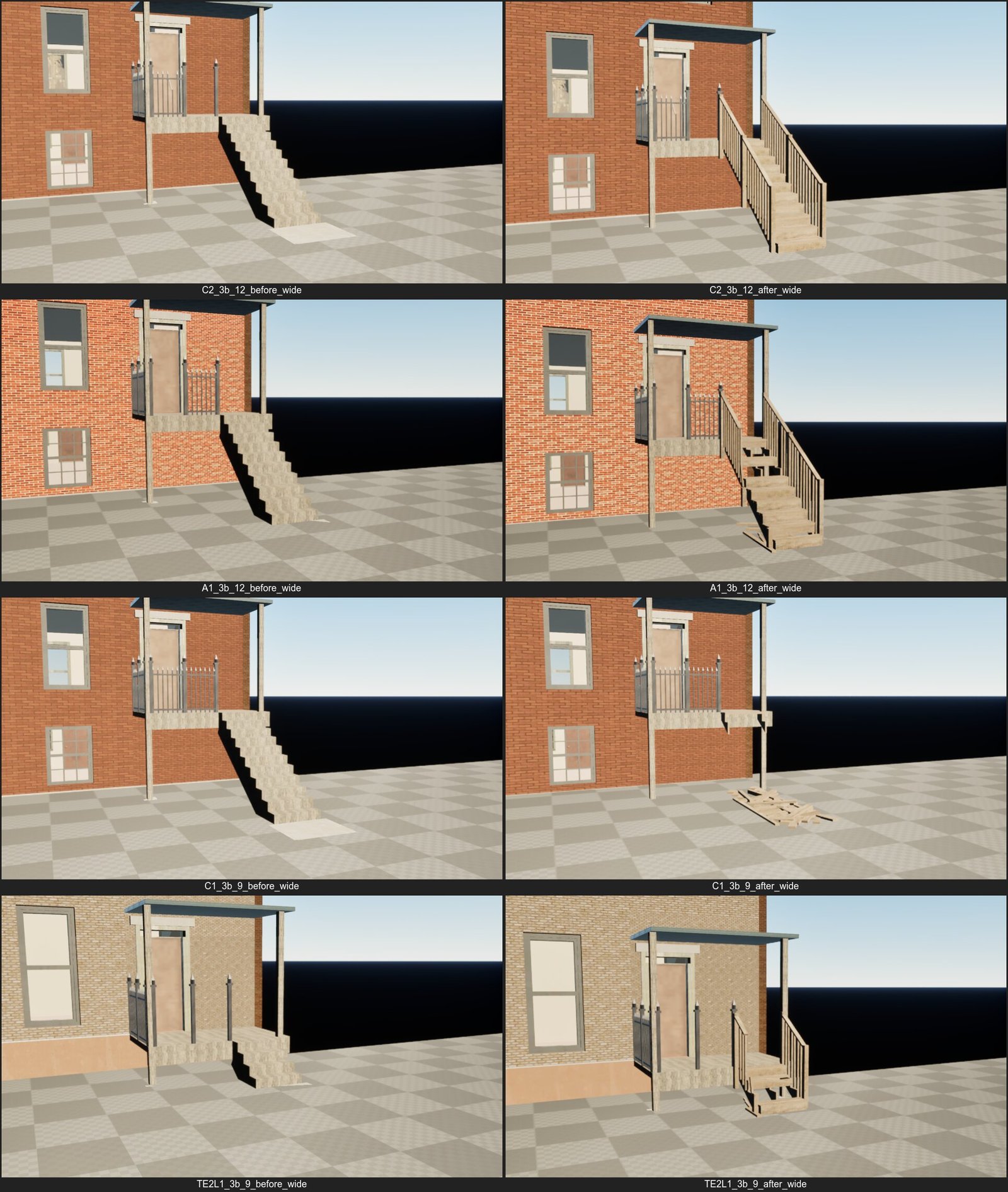
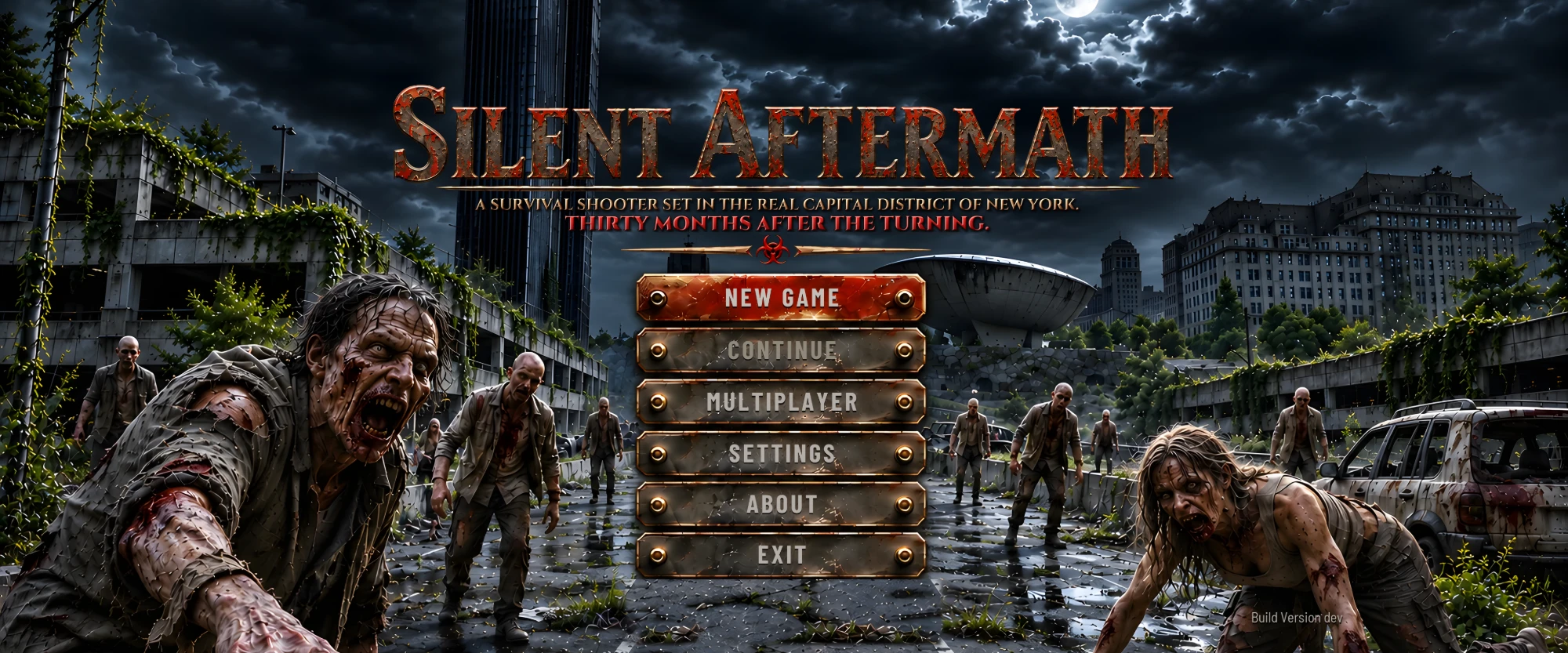
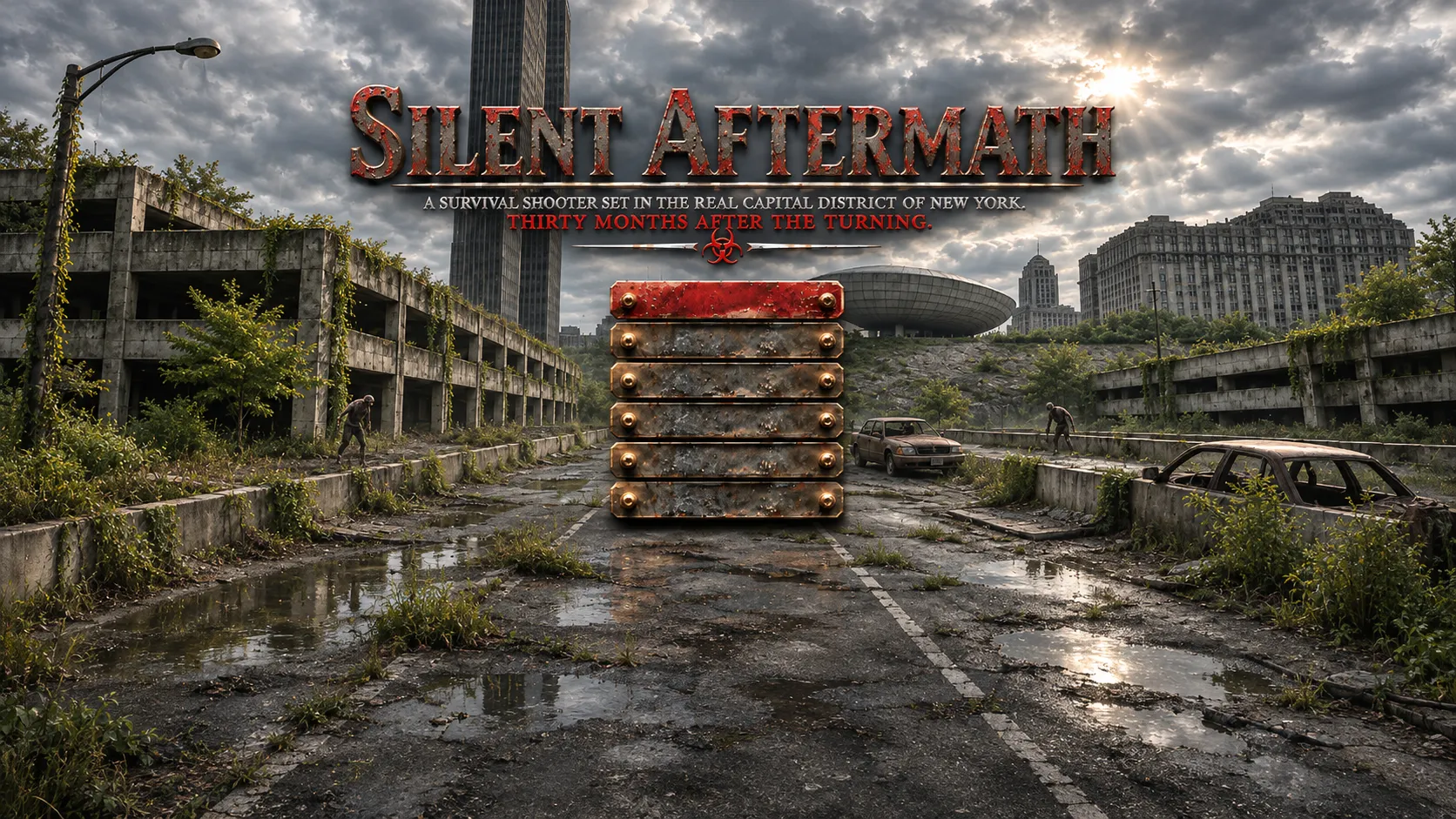
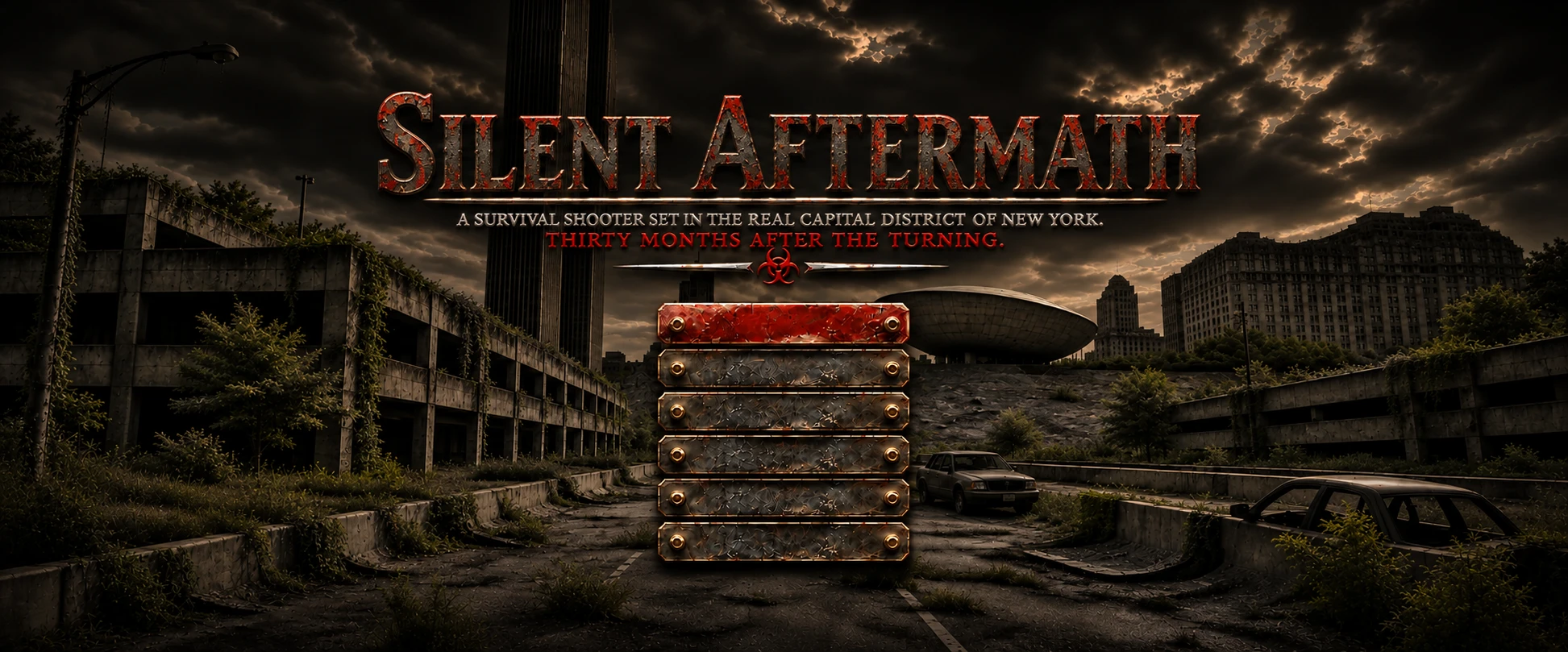
There the rowhouses stand on their real lots: front door in a side bay, the stair hall behind it, a walkable ground floor and a garden level below the stoop. Streets have heaved paving, weeds in the joints, trash and boarded windows, and no two neighbouring windows are boarded the same way. The main menu sits on the Empire State Plaza and follows the clock on your computer, with a day, a dusk and a night picture.
Coming: more of the city, block by block, and large areas of ruin from earthquakes and storms.
A Troy rowhouse, rear stairs, before and after
— Sol Reyes, World Designer
Weather
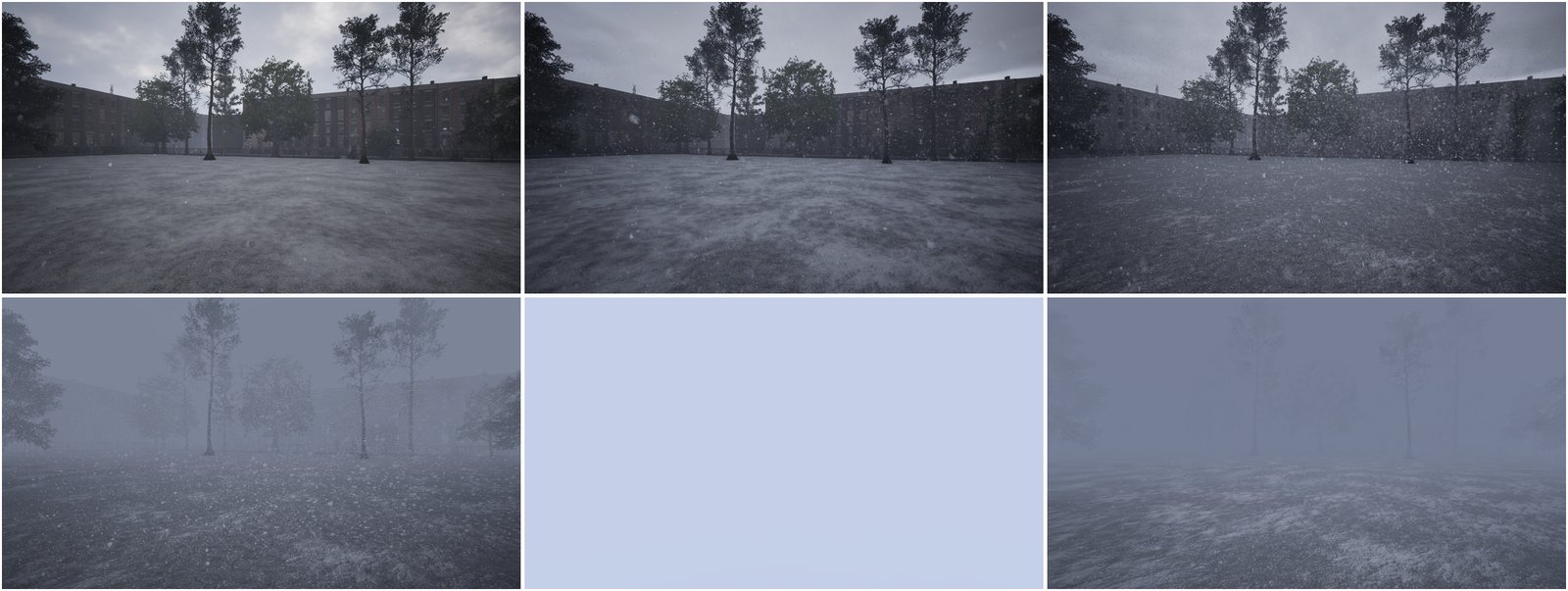
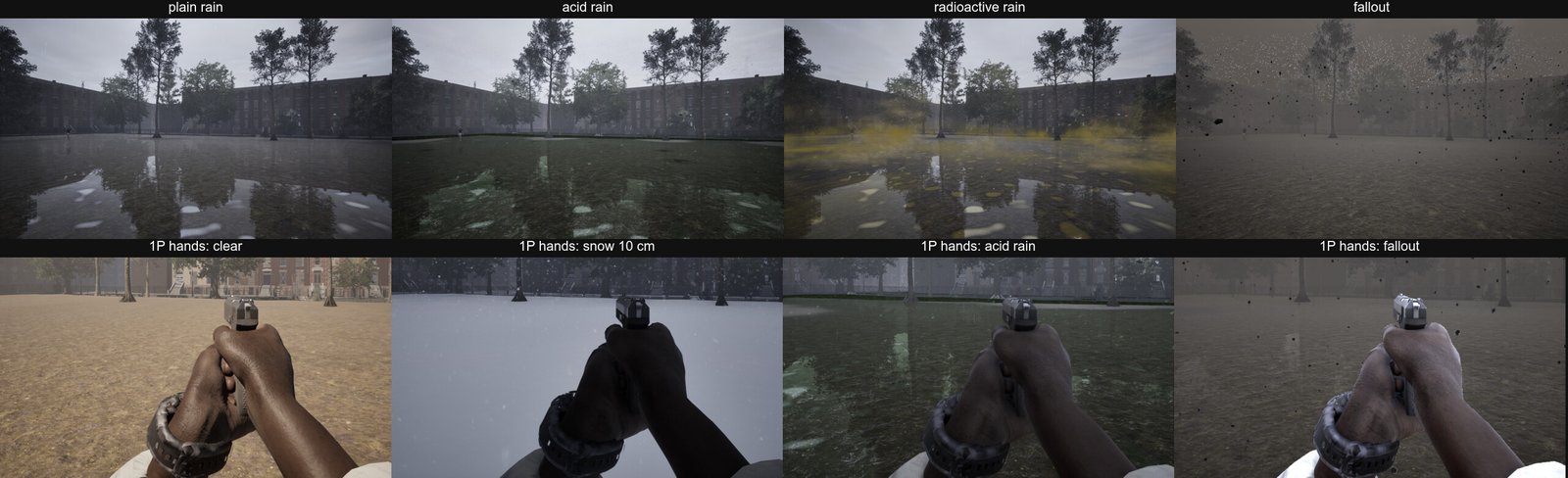
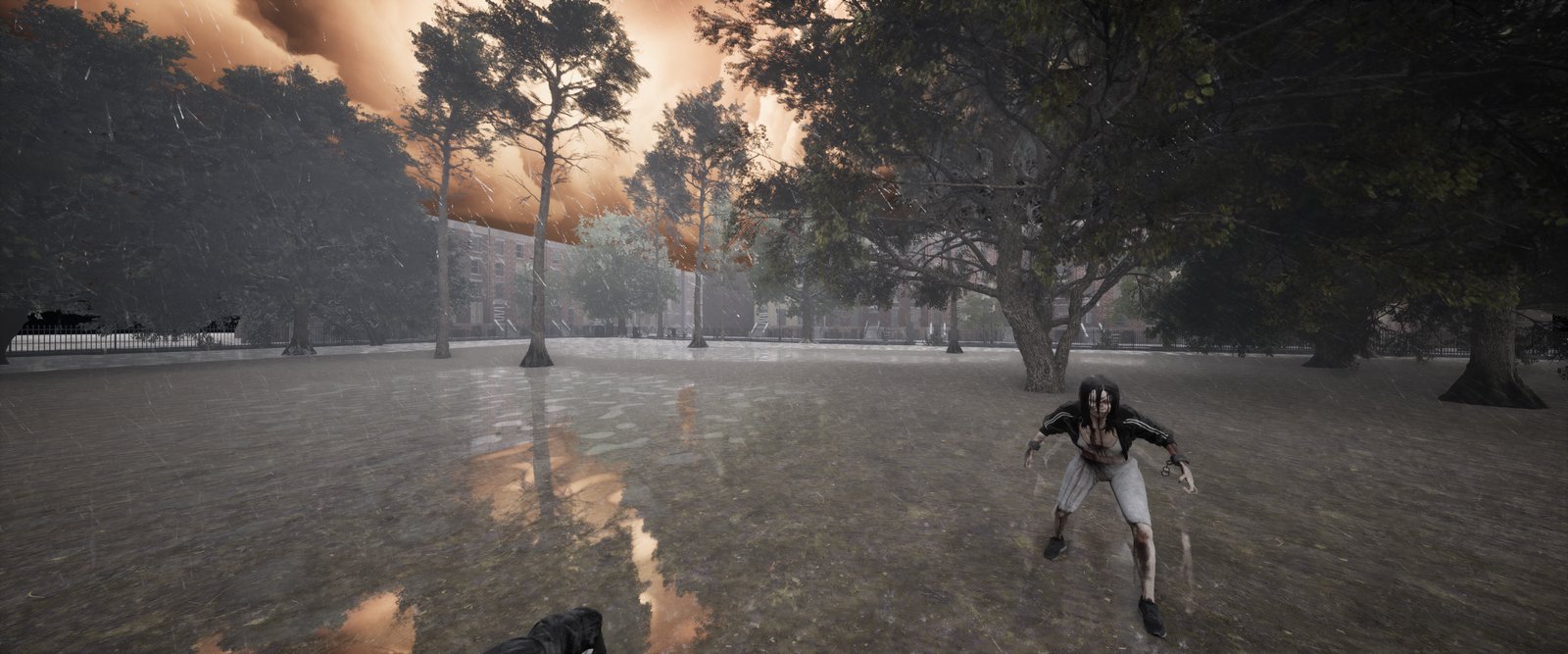
The sky is now a system, not a backdrop. You get snow that settles and melts (six kinds, from light flurries to a cyclone), four kinds of fog, the Whiteout, hail, and three toxic rains you can tell apart: acid, radioactive and fallout. Each changes how far you can see and how your body copes.
Storm winds bend the trees and push against you when you walk. Snow has its own footsteps. Earthquakes arrive on their own, shake the world and you, and bring aftershocks. Acid rain eats exposed gear layer by layer before it reaches your skin.
The tornado and the dust storm are being reworked; they are not where we want them yet. The chaotic end-of-the-world skies for the extreme weather are coming.
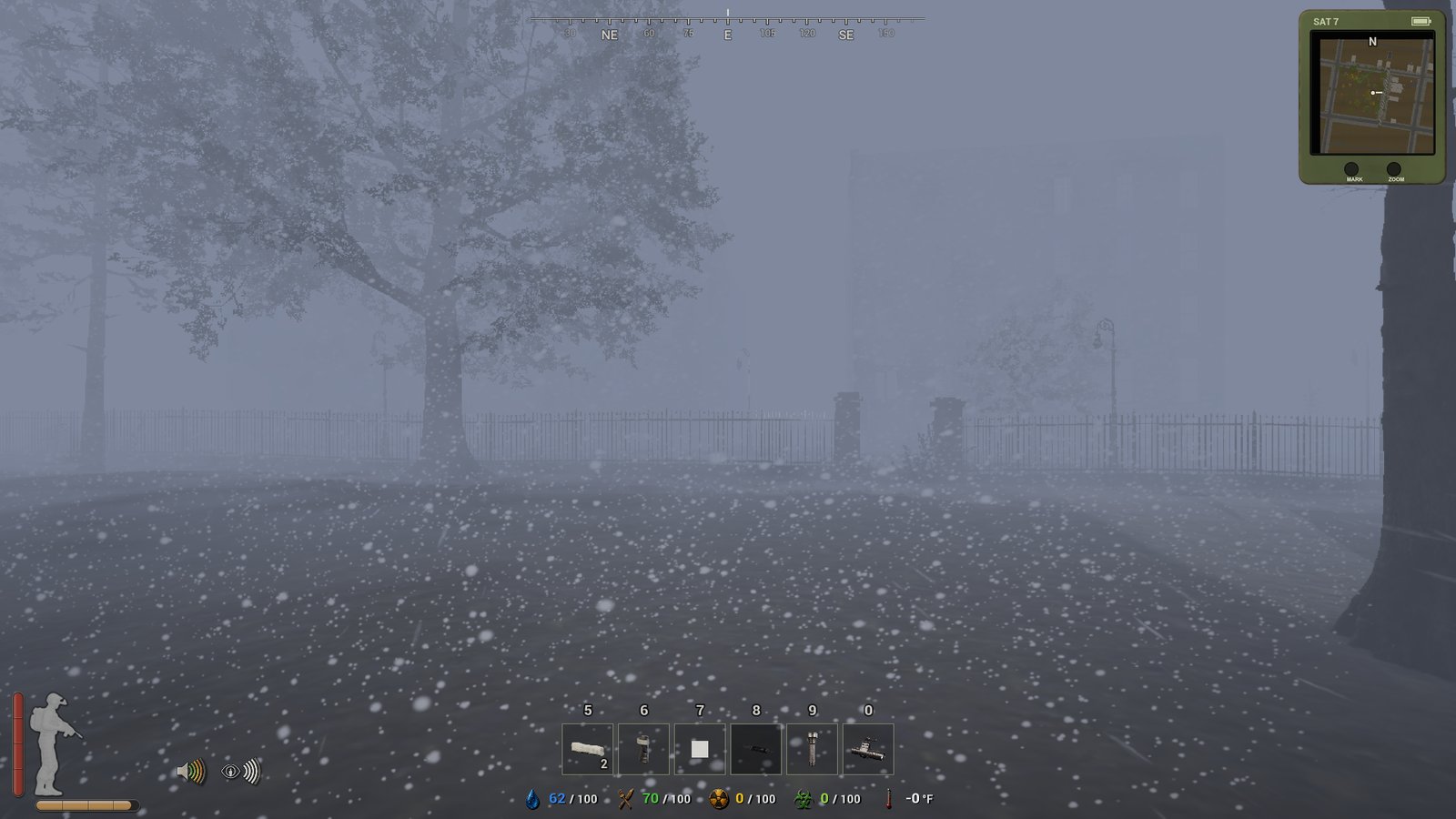
Six snow types, light flurries to cycloneWhiteout: dense fog with snowPlain rain, acid rain, radioactive rain and fallout, and the hands in eachStorm winds bending the trees
— Mara Lind, Technical Artist
Health and survival
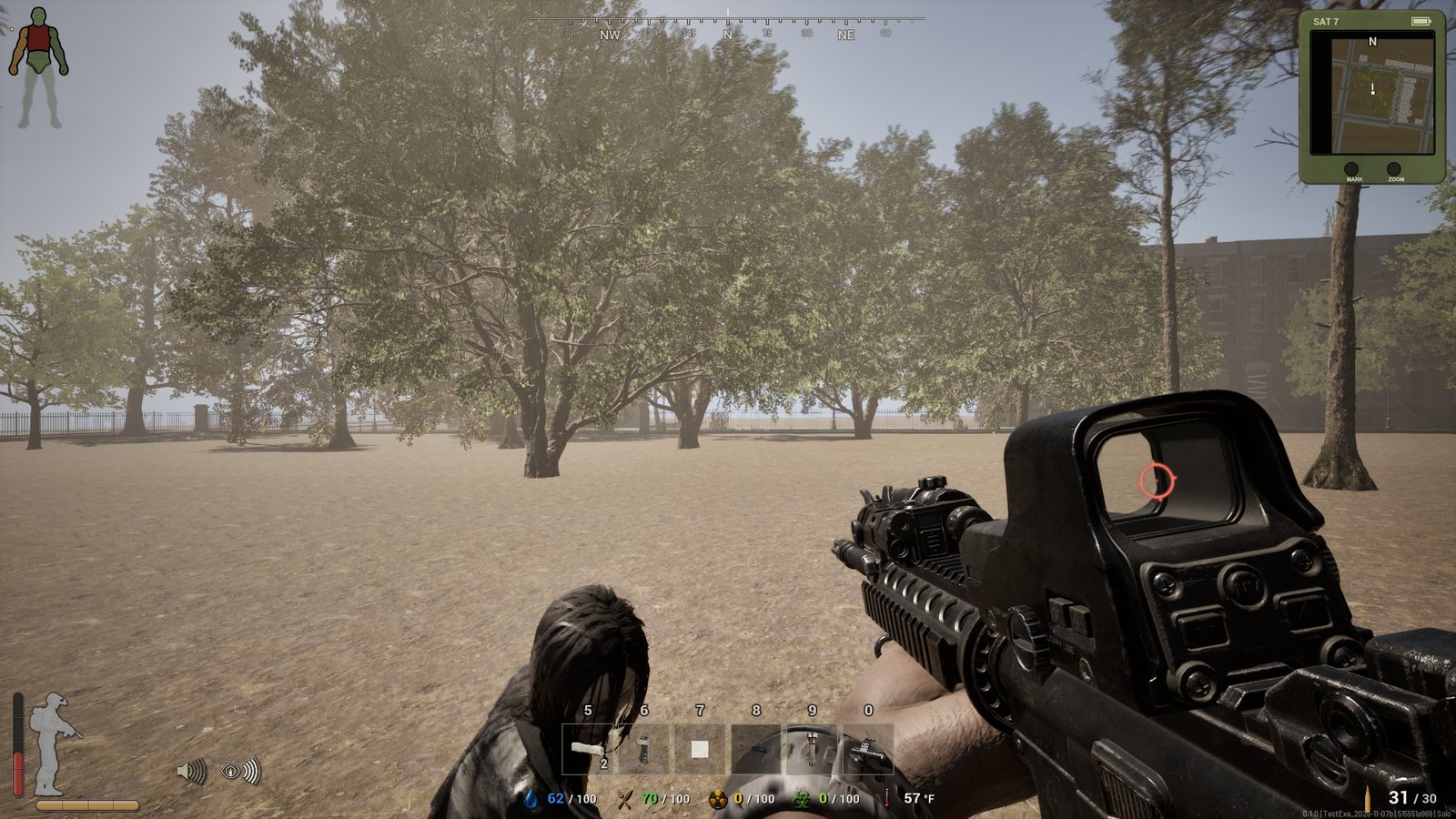
Your body is simulated part by part. Bleeds, fractures, pain, infection and cold are treated where they happen, and you can treat other survivors. Food and water drain with time and effort. Cold makes you shiver and heat dries you out, and both slow you down and lower what you can carry. The HUD thermometer shows the air outside, and a radiation counter reads your dose.
You are one character for the whole game, and your body stays where you fell. Clothes show wear, and your skills are learned by doing.
Coming: making fire with wood, sticks and tinder, and clothes that visibly fall apart with condition.
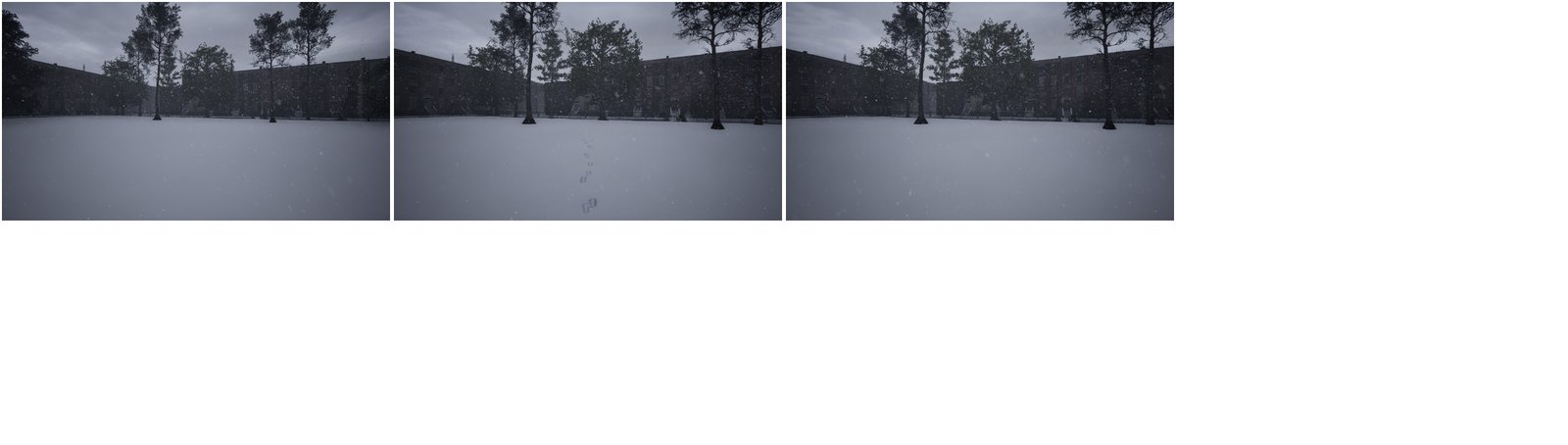
A footprint trail in settled snow
— Nadia Okafor, Survival Designer
Weapons
Bullets fly, armour stops some of them, guns wear out and jam, and you clear a jam by hand. Guns are drawn and held the way Escape from Tarkov does it. The M4A1 is our first gun finished end to end, with its recoil cut by 60 percent.
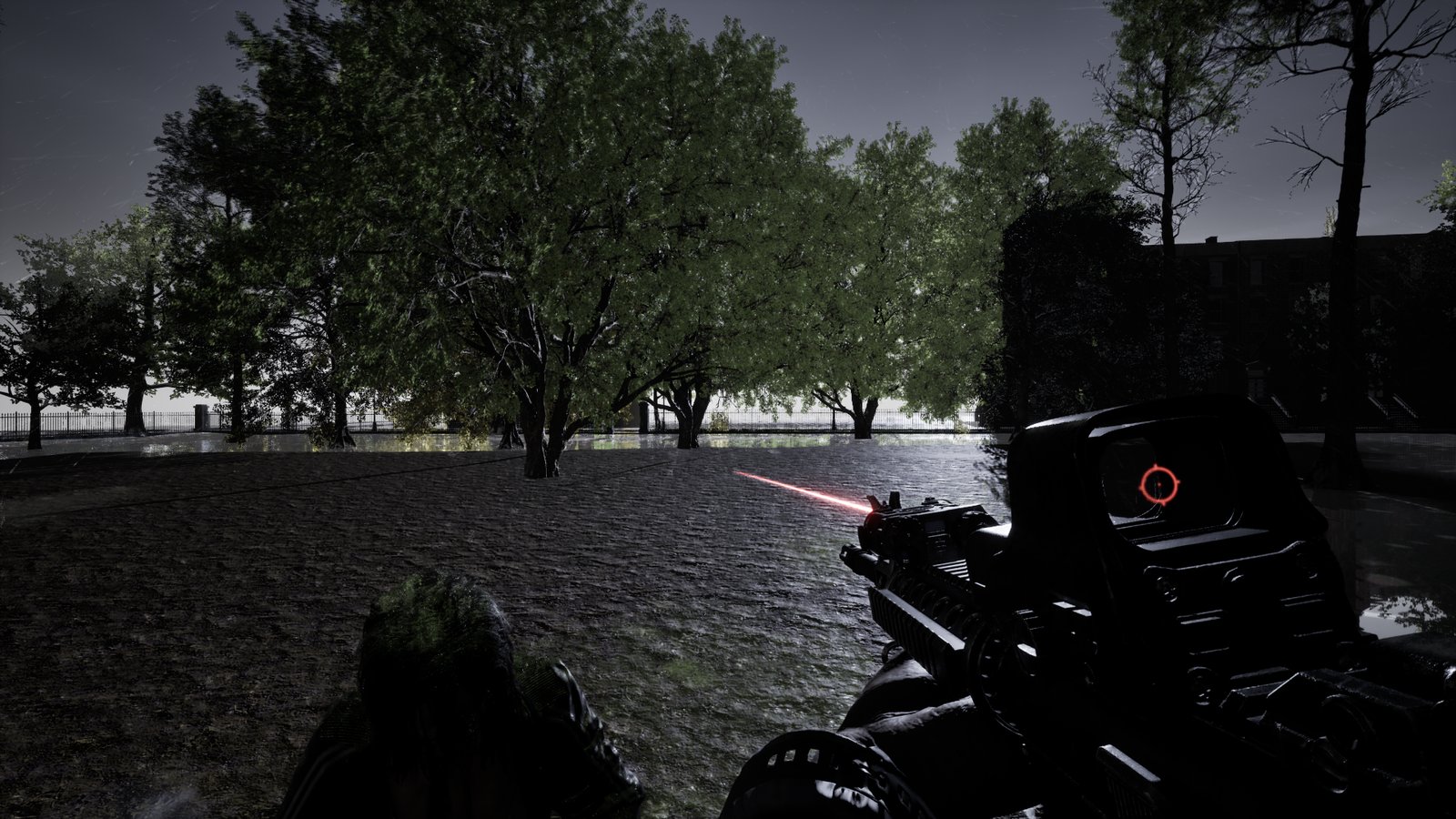
Attachments sit on real rails. A four-rail handguard shows four slots, and a light or laser fits on any of them. A laser now draws its beam, and one key (T) turns it on and off. Twenty-seven new sights have been added: holographic and reflex sights and more from optics packs. A flip-over 4x magnifier is back on the M4 and is still being tuned.
Coming: a proper flashlight grip in the right hand, faint outline silhouettes in empty attachment slots, and a more physical flashbang (stagger and sway).
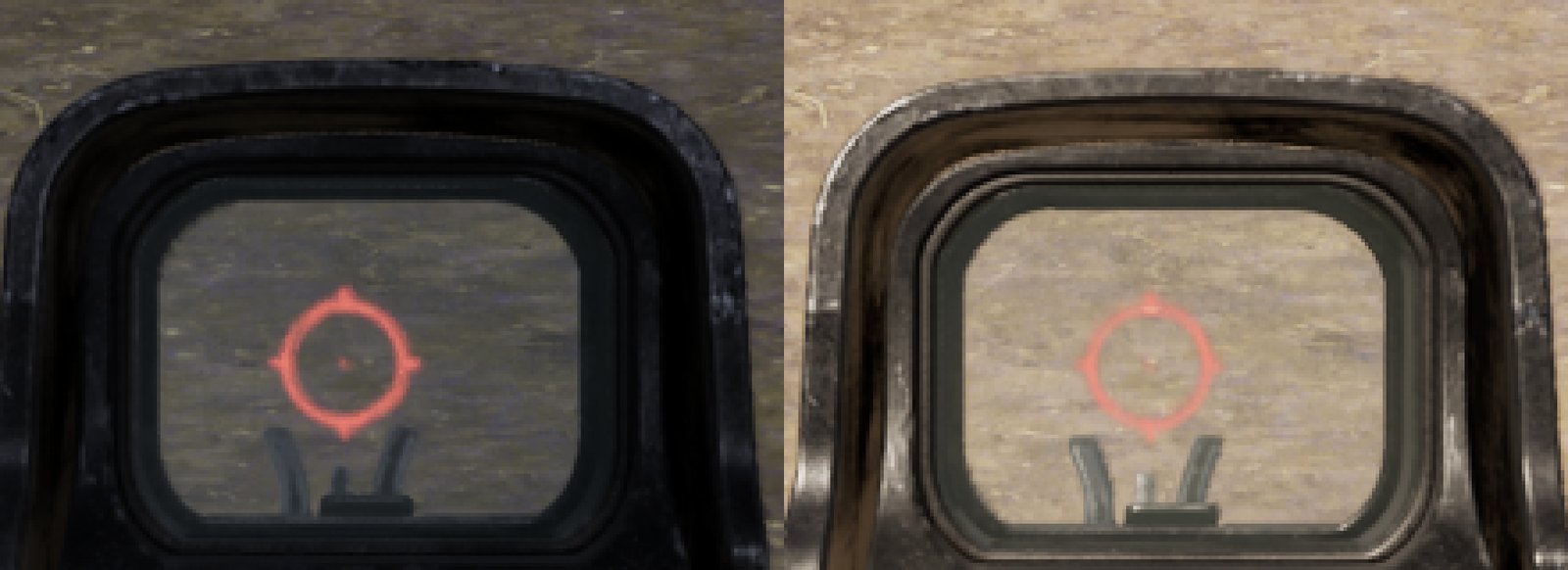
A laser on the M4, beam drawnHolographic reticle brightness, 4x close-up
— James Marcellus, Weapon Smith
Inventory and the Character screen
A grid inventory where weight and space matter, with containers inside containers. A plate carrier holds nothing until you attach pouches. Examine opens a floating window over the inventory so you can drag parts into a gun. Ammo stacks change their picture with the count, and rounds dropped on the ground pile up.
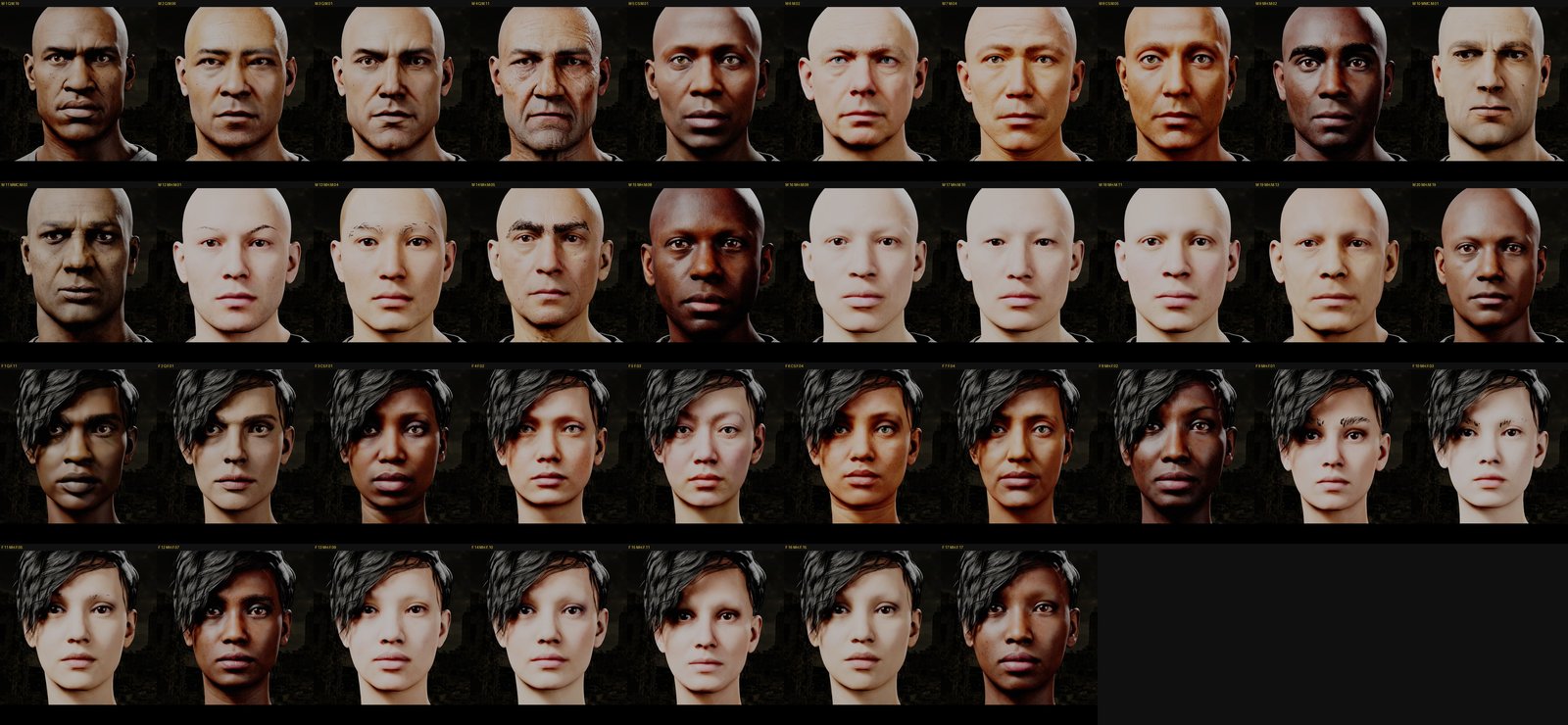
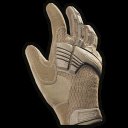
Every head on the creation screen now has its own real skin: four sets of five faces. The coyote tactical glove is your hand when you interact, and it changes pose with the action.
Every head with its own real skinThe coyote tactical glove reaching to interact
— Priya Shah, UX Designer
Skills
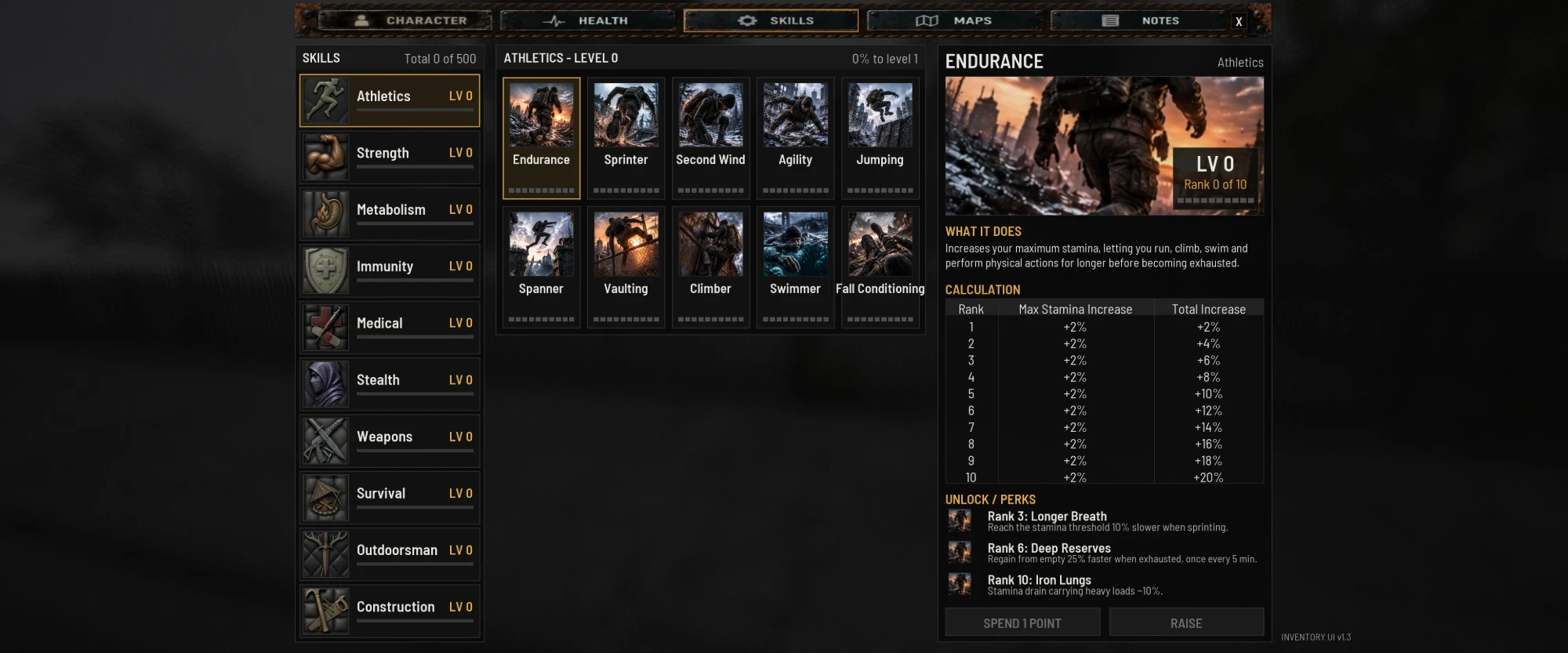
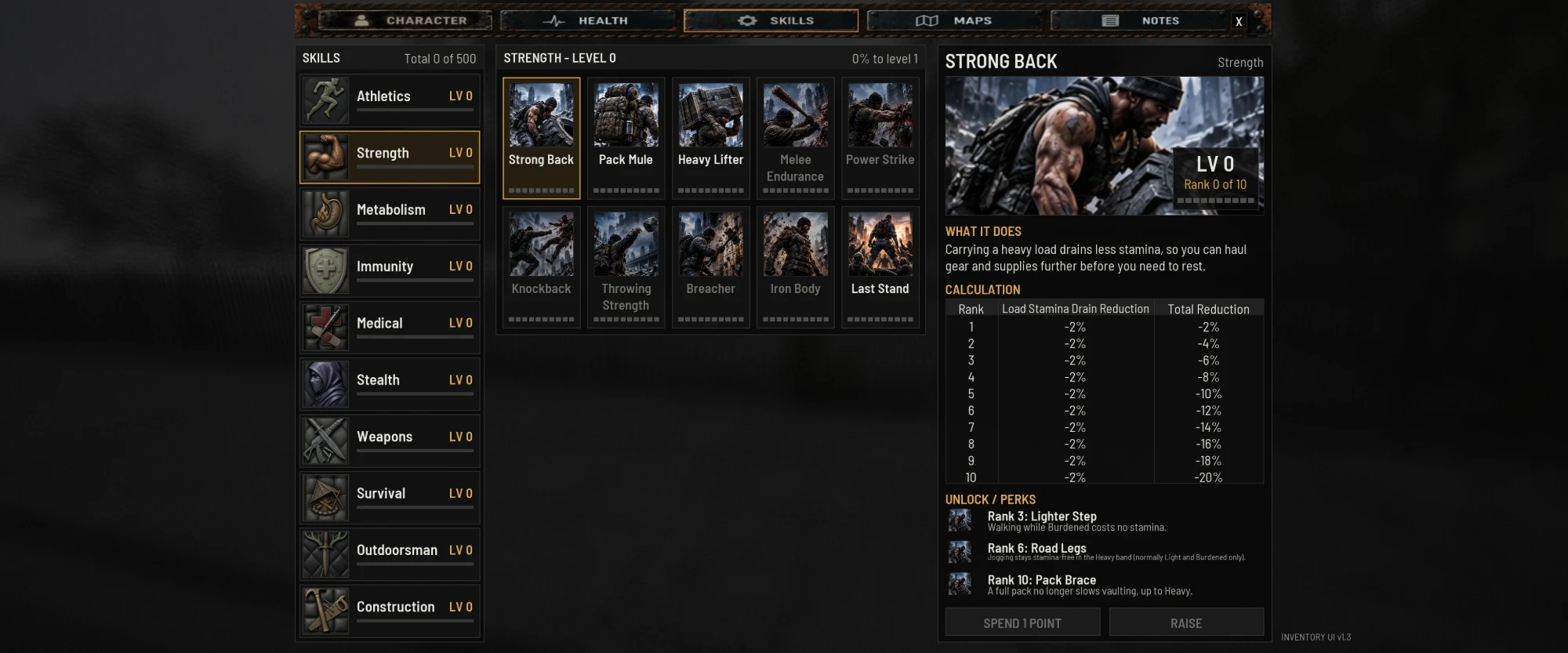
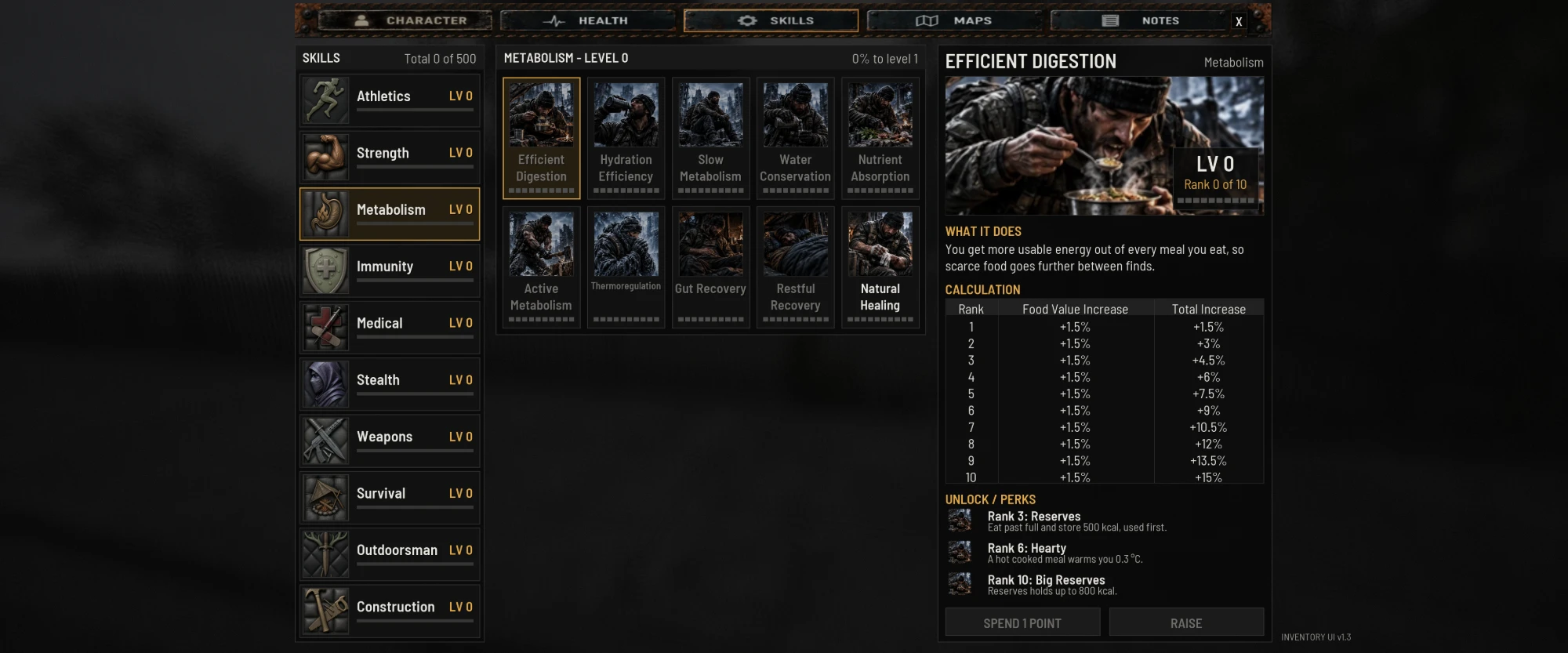
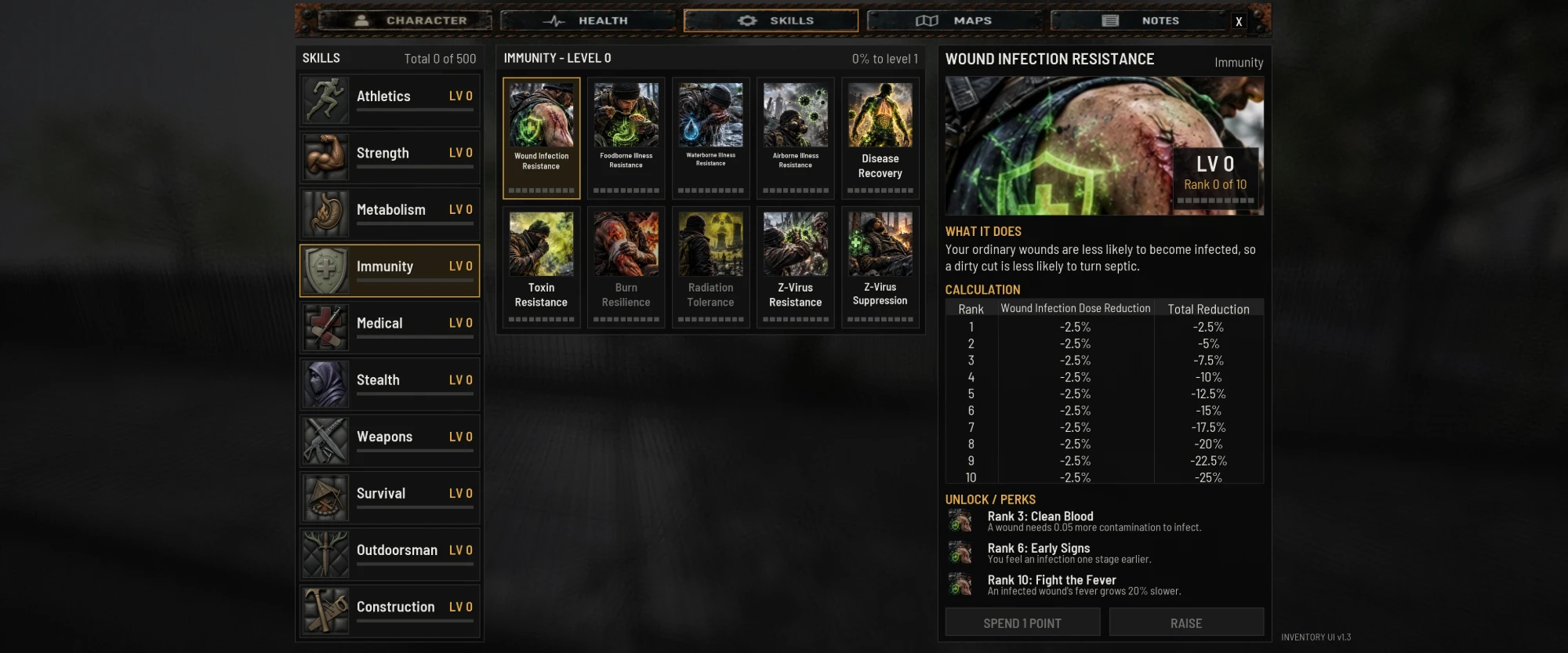
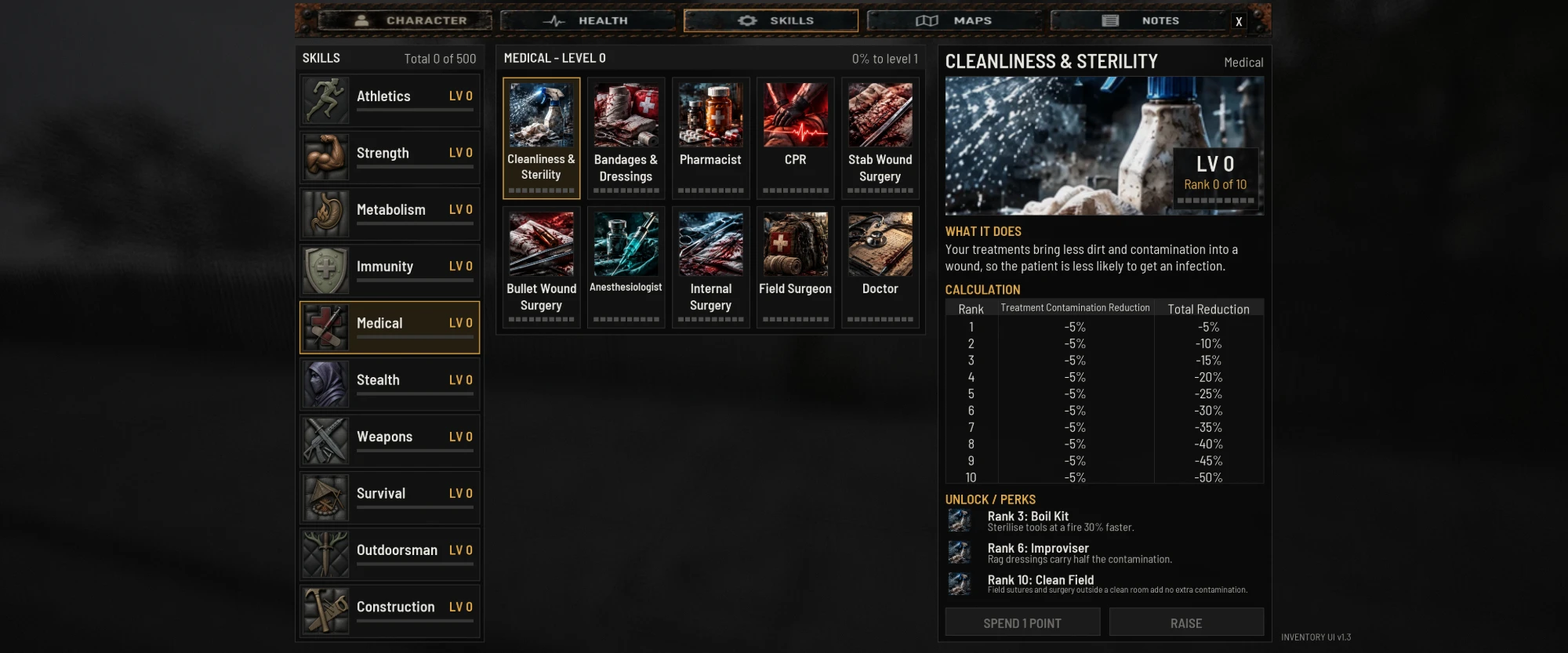
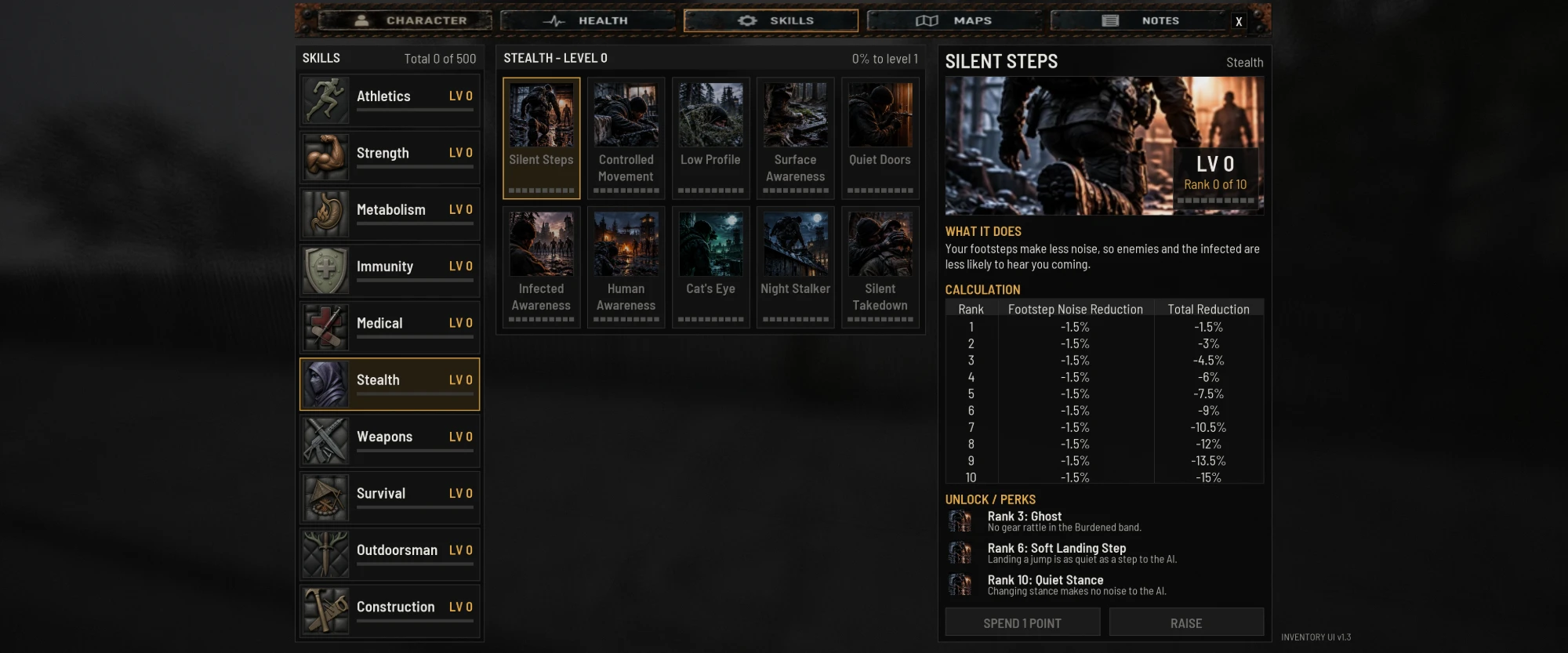
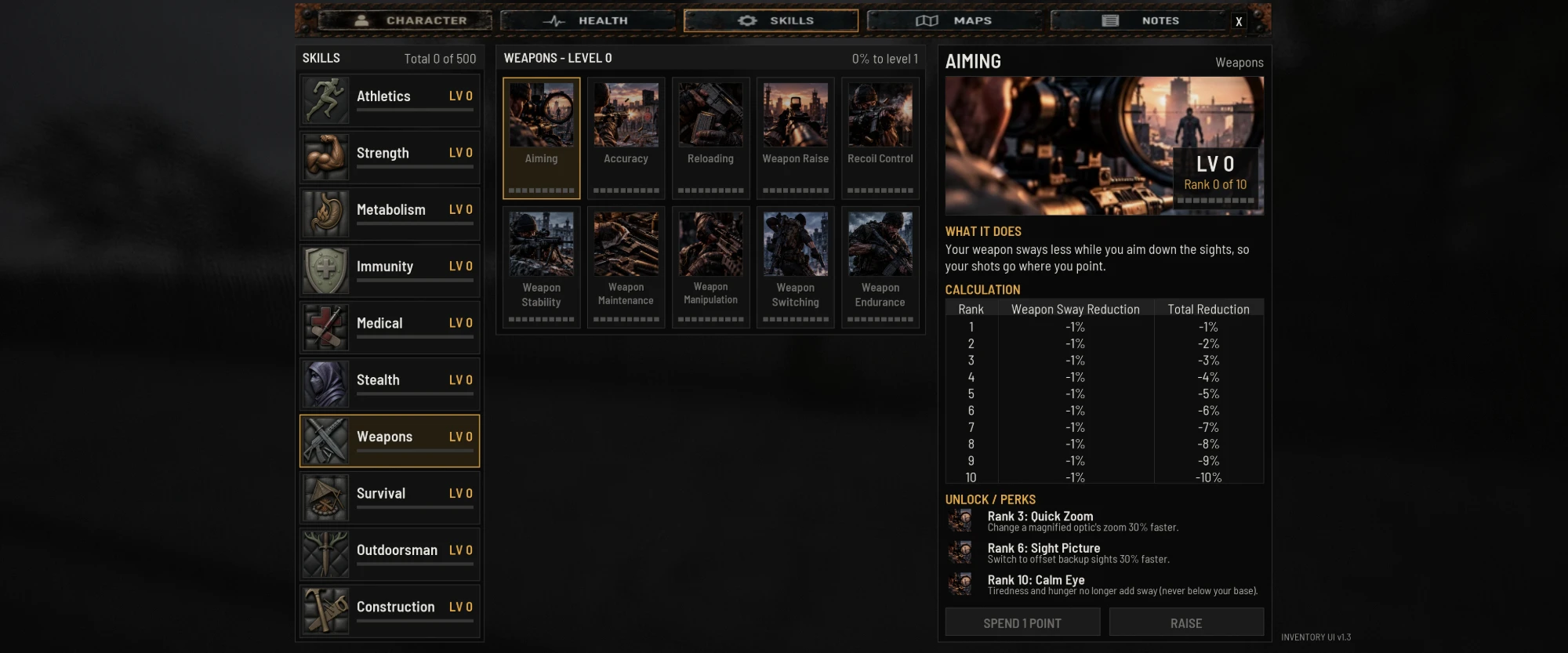
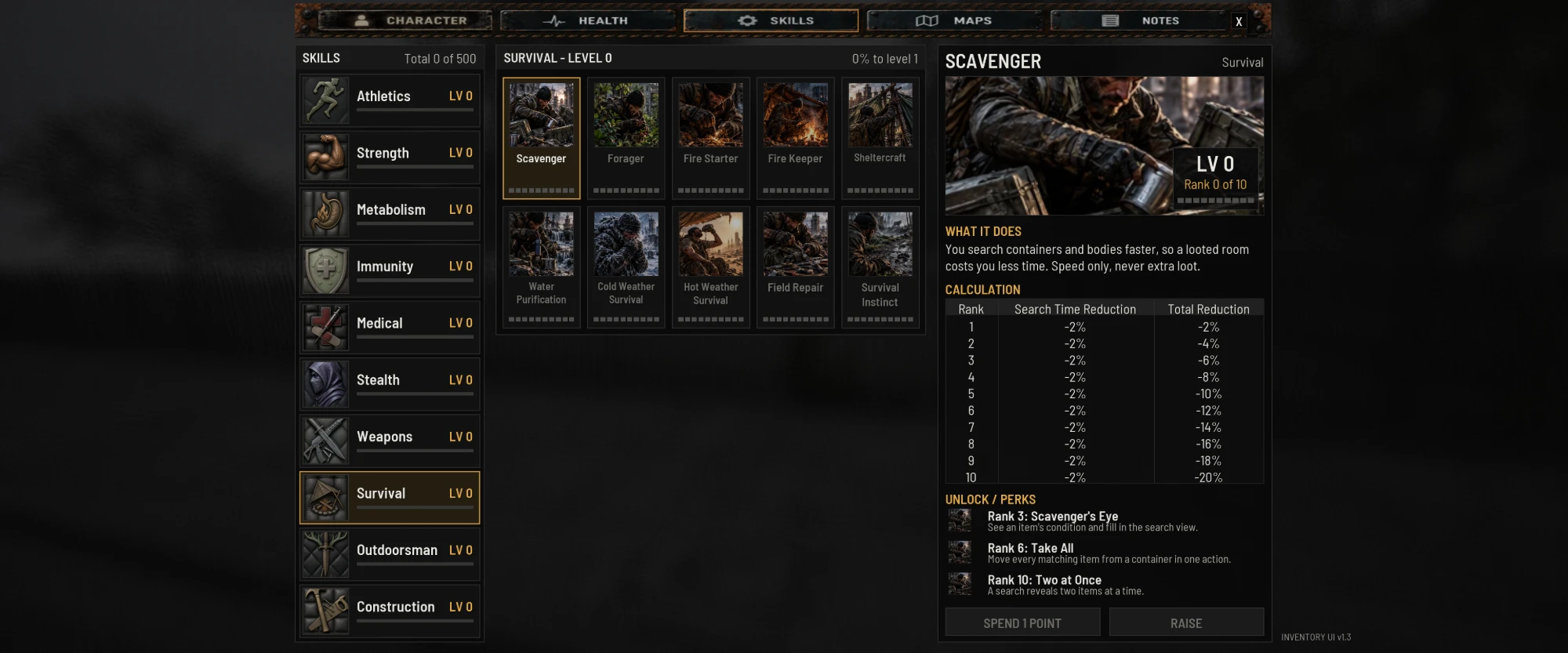
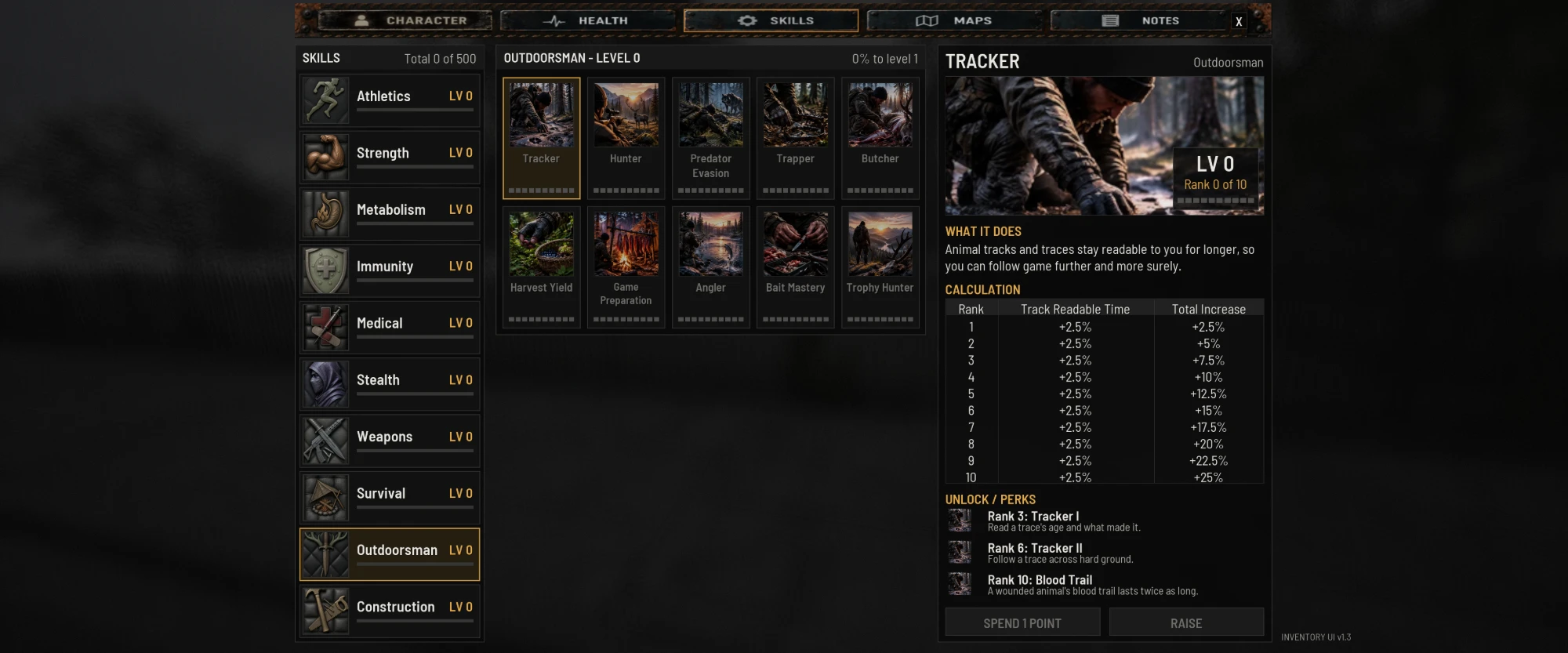
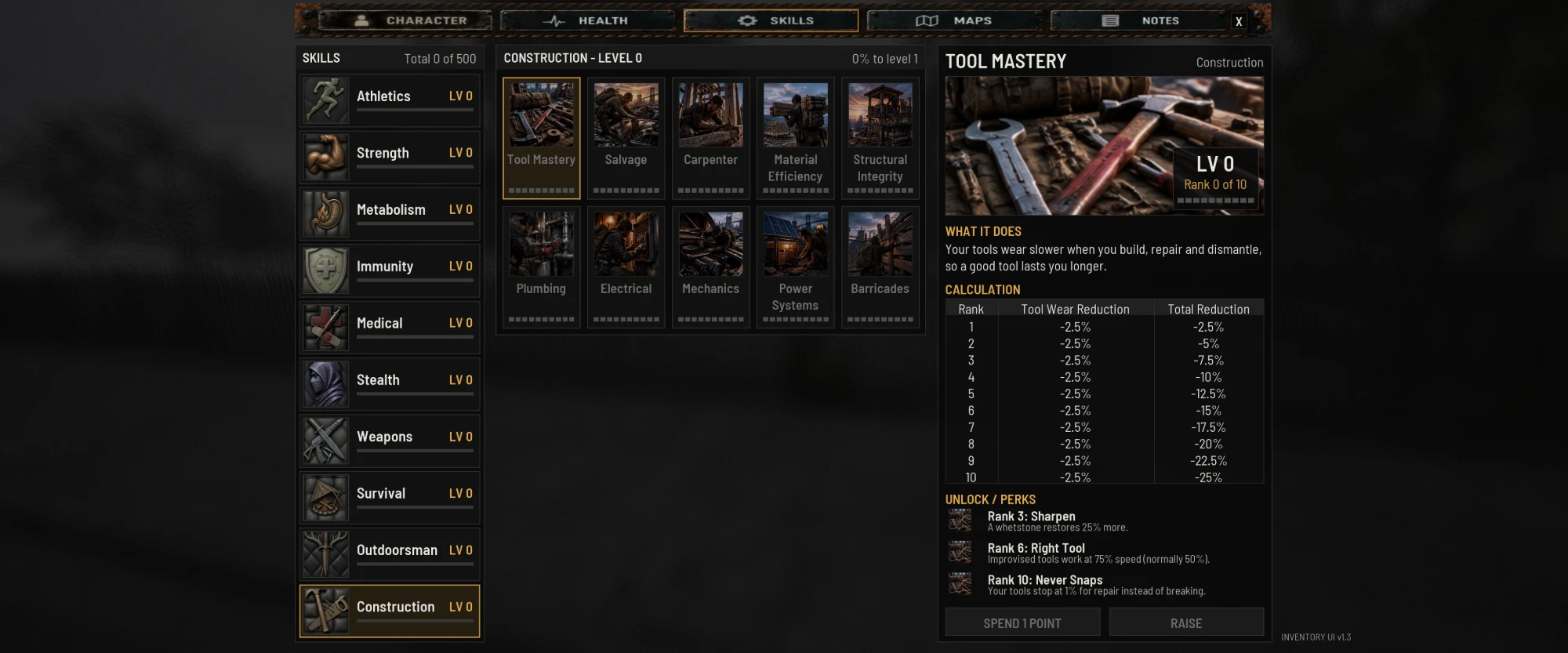
Ten skills with ten perks each: Athletics, Strength, Metabolism, Immunity, Medical, Stealth, Weapons, Survival, Outdoorsman and Construction. Every perk has ten ranks, with special unlocks at 3, 6 and 10. Each gun you use also builds its own mastery: accuracy, vertical and horizontal recoil, reloading, jam clearing and maintaining.
The Athletics skill tab
— Priya Shah, UX Designer
Building and barricades
Doors open with F, swing when you walk into them, and can be locked, kicked or broken. Barricades fit doors and windows of any size. B opens the build menu, which lists barricades and buildings.
Coming: barricades you draw by hand (click a door or window, drag a frame, then add materials or hammer planks in one at a time), a barricade door with a wooden drop bar, and foundations, walls, stairs, roofs and fences from the same menu.
— Ruth Calder, Building Designer
The infected
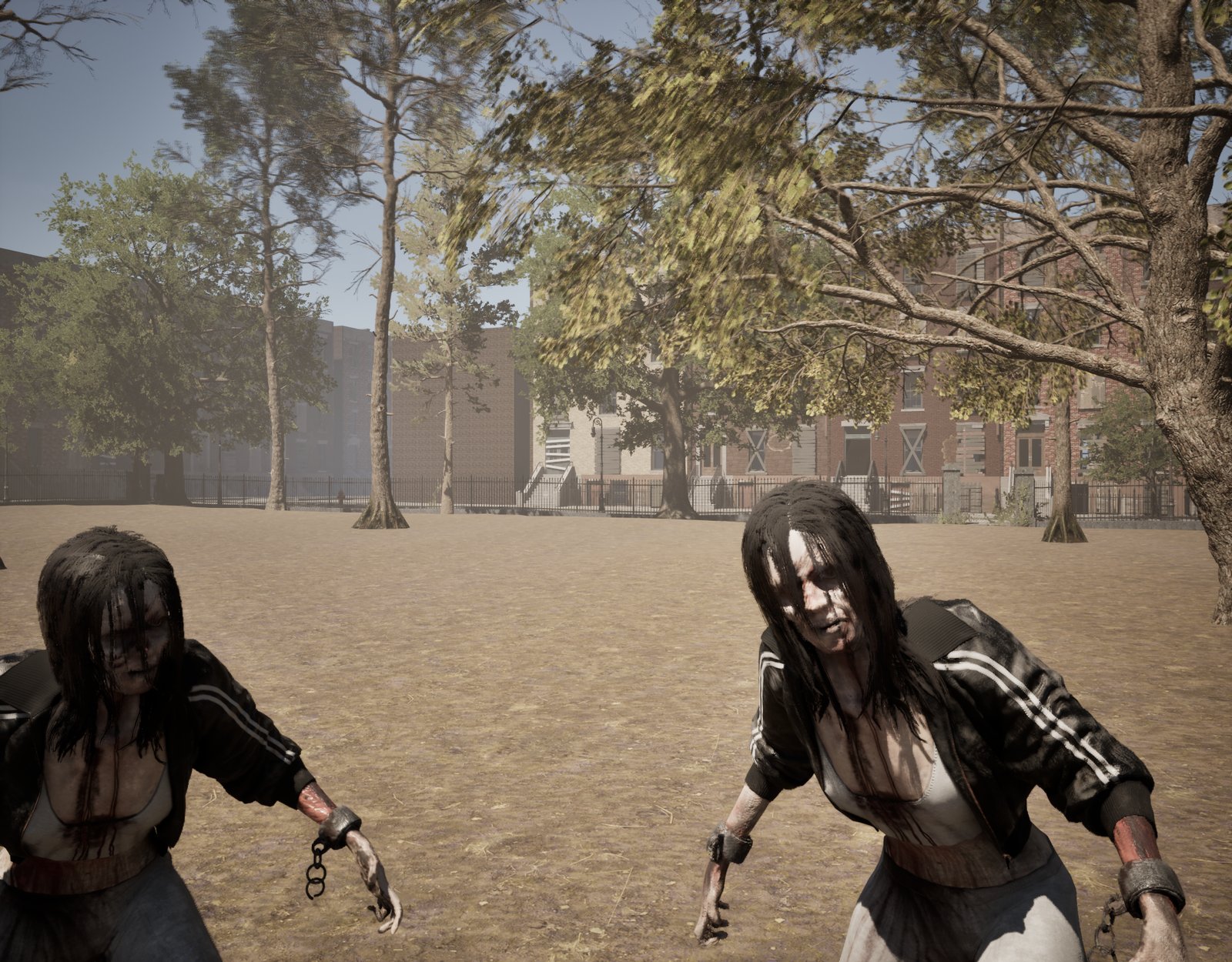
The infected come in stages. The freshly turned have bloodshot eyes, by stage three the eyes have gone grey, and the Shades, who cannot stand UV light, have orange ones. They see, hear and smell you. Each limb has its own hit points, ruined limbs go limp, and a body falls the way it was hit.
We scrapped a stand-in body that did not look real enough. The infected are being redone with our own look, and we will show it in pictures first. Human enemies, bosses and animals are ahead.
— Viktor Hale, Encounter Designer
Admin tools
Server admins get a board for server settings, a world tab with weather and the time of day, a spawn menu of 494 items, God mode, Invisible, and switches that make the infected or other NPCs ignore you. A small version line sits at the lower right of the HUD so every report names its build.
Admin Invisible: no player drawnThe version line at the lower right of the HUD
— Jules Ortega, Content Engineer
Servers and saving
Dedicated servers where the server checks everything, and your own single-player world on the same code. Each server keeps its own characters, tied to your Steam ID. The game is designed for up to 64 players in the 20 by 20 km map. Steam and Epic are both planned, with a server browser. We will give real numbers once the big load tests are done.
— Adrian Sato, Backend & Cloud Engineer
Sound
Alarms from the Night Hunter sound set are in, along with footsteps that change on snow, quake rumble and rattle, and storm sounds. Shots near, far and suppressed are in for the M4A1.
— Ezra Cole, Audio Designer
What is next
Drawn barricades, then the rest of building. Our own infected look. More guns, one at a time, each finished fully. Vehicles are in progress. After that: traders, factions and more of the map.
Thank you for following along. Tell us what you think in #ideas-and-feedback.
— Rhea Vance, Design Director
Dev Diary #18 — A main menu that keeps your time
2026-11-05
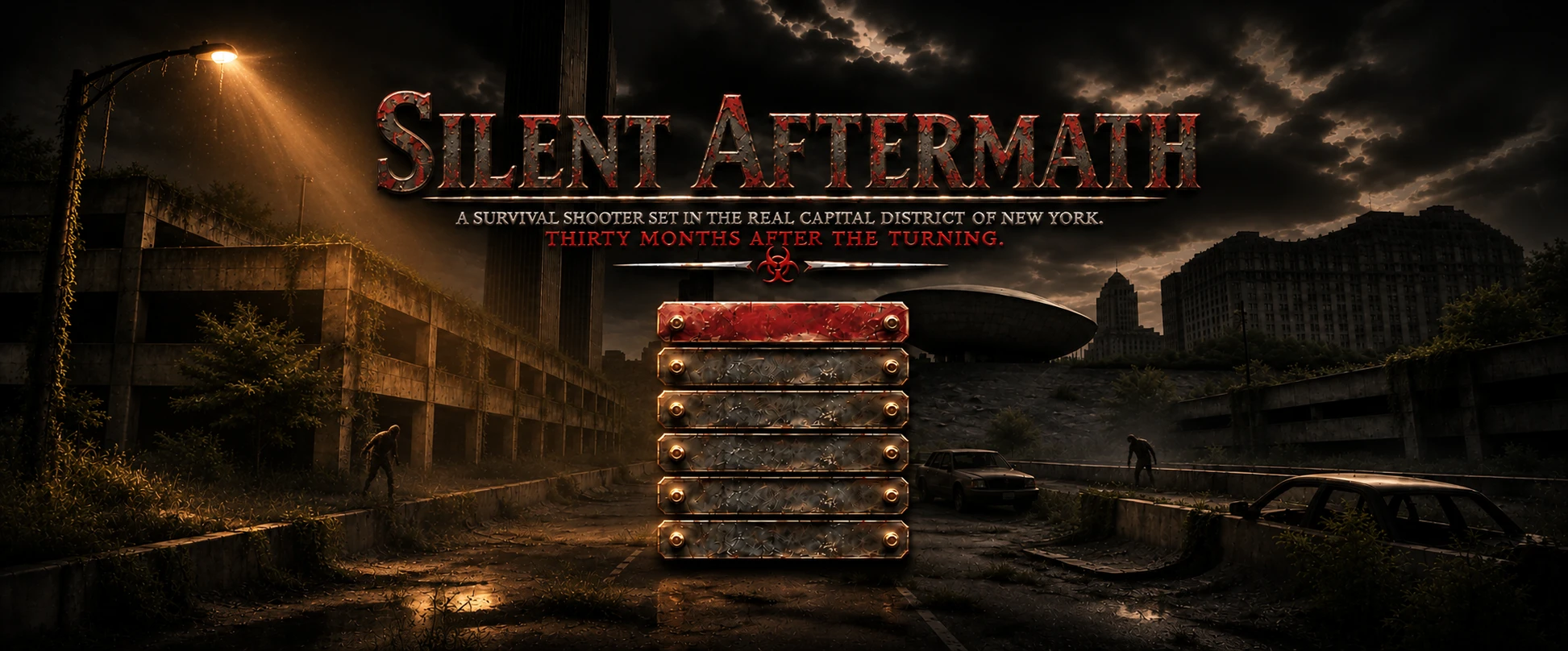
The first thing you see when you start Silent Aftermath is now the Empire State Plaza, thirty months after the Turning. The Egg and the Corning Tower are still standing, the parking decks are giving way to the vines, and the roads are breaking up under the weeds.
The menu follows the clock on your own computer. Start the game in the afternoon and you get a grey day with the sun breaking through. In the evening and at dawn it's dusk over the plaza. After 7 at night the last working street lamp comes on, it's raining, and you're not alone out there.
Day: 7 am to 5 pm Dusk and dawn: 5 to 7 in the evening, and 5 to 7 in the morning Night: 7 pm to 5 am
If you leave the menu open as the clock turns over, it fades into the next scene.
Here it is in the game, at night:
The main menu in the game at night
DayDuskNight
— Priya Shah, UX Designer
Dev Diary #17 — The Skill system: all 10 skills
2026-10-30
Everything you do makes you better at it. Run and you get fitter. Patch wounds and your hands get steadier. Build and you build faster and stronger.
There are 10 skills with 10 perks each: Athletics, Strength, Metabolism, Immunity, Medical, Stealth, Weapons, Survival, Outdoorsman and Construction. Each perk has 10 ranks and shows exactly what every rank gives you, with special unlocks at ranks 3, 6 and 10.
Two big things are in progress. Neither is in a test build yet, so this is where they stand, not a finished feature.
Vehicles (in progress) The first two drivable vehicles are a pickup truck and an armoured personnel carrier. Walk up to a door and it opens. Get in, get out, close it behind you. Start the engine and you hear it. A fuel gauge and the gear you're in sit on screen while you drive. — Sol Reyes, World Designer
Driving controls W, A, S and D to drive, Space to brake, Q and E to shift through the gears with a neutral, L for headlights, H for the horn, Left Shift for a boost. They only apply while you're driving. — Sol Reyes, World Designer
The infected (in progress) The first test infected are walking our Troy test area. They're not in a test build yet. Fighting them, how they take damage and how they go down are still being built, and their look is being reworked so they read as the newly dead. — Viktor Hale, Encounter Designer
Next up: more as it reaches a test build.
— Sol Reyes, World Designer
Dev Diary #15 — 974 things worth finding
2026-10-29
We counted everything you'll be able to find: 974 different items. Colour versions of the same thing count once.
What's in the pile - 450 pieces of clothing and gear - 186 weapon attachments - 90 weapons - 66 tools - 54 kinds of ammo - 42 medical items - 27 vehicles - 19 foods and 11 drinks - 15 containers - 8 crafting materials, 4 keys and documents, 2 kinds of junk — Felix Brandt, Economy Designer
Weapons, by class 16 assault rifles, 16 melee weapons, 12 shotguns, 9 throwables, 8 submachine guns, 7 bolt-action rifles, 5 pistols, 5 placed explosives, 4 assault carbines, 3 light machine guns, 2 revolvers, 2 marksman rifles and a shield. — Felix Brandt, Economy Designer
What you wear, by slot 100 torso, 58 legs, 52 head, 40 belt, 32 face, 31 rig attachments, 30 backpacks, 29 rigs and vests, 20 feet, 17 eyes, 16 hands, 10 armour plates, 9 ears, 6 wrist. — Felix Brandt, Economy Designer
Becoming the wiki This list is becoming part of the game's wiki, with a picture of every item, so you can look up what you just found. — Felix Brandt, Economy Designer
Next up: what's on the way.
— Felix Brandt, Economy Designer
Dev Diary #14 — Guns brought to life
2026-10-29
The M4A1 is the first gun we're finishing end to end. Here's where it stands, and what comes after it.
The M4A1 in your hands Aim, and the rear sight lines up on the front post. The rifle carries a holo sight with clear glass and a clean reticle. Recoil is down by 60 percent. You can fit and remove a light, a laser, a vertical grip and a suppressor. Its full set of sounds is in: shots near, far and suppressed, plus the reload and the bolt. — James Marcellus, Weapon Smith
A flash that doesn't blind you The muzzle flash was a blinding light at night. Now it's small and short. — Mara Lind, Technical Artist
Being animated and brought into the game Every gun is moving to a complete, proper set of animations for holding, aiming, reloading and carrying. The M4A1 is first, and the M249 and M240 machine guns are in progress too. After the M4A1, one at a time: an AK-pattern rifle, a marksman rifle, a sniper rifle, an SMG, a pump shotgun, a pistol and a revolver. — James Marcellus, Weapon Smith
Next up: 974 things worth finding.
— James Marcellus, Weapon Smith
Dev Diary #13 — Fit and stride
2026-10-29
How your survivor moves, and how the clothes sit on them while they do it.
Stand up straight The jog used to hunch forward. Now you run upright, the way a person runs with a rifle and a pack. Walk, jog and sprint all play properly, with no frozen or sliding legs. Prone works too: face down, crawling, and firing the rifle from the ground. — Tomás Rivera, Animation Designer
Clothes that fit We refitted 39 pieces of clothing, so your skin no longer shows through trousers at the thigh or through boots while you move. A few sleeves and collars are still being fixed. — Jules Ortega, Content Engineer
The Character screen Test builds start you with a try-out kit: a belt with a holster and a Glock on the hip, a rig, an M4A1, a shotgun, a knife, grenades, a flashlight, night vision, a GPS and a compass. Pouches attach to a plate carrier, never on their own. The helmet has its own section, with a night vision mount and a battery slot. Every gear box is the same size, and the weight counts every part you've attached. — Priya Shah, UX Designer
Next up: guns brought to life.
— Tomás Rivera, Animation Designer
Dev Diary #12 — A face worth surviving with
2026-10-29
You'll be looking at this survivor for a long time, and so will everyone you meet. Character creation is being rebuilt right now, so this is where it's heading, not a finished feature.
Every head a different person 32 realistic heads, 16 male and 16 female, and every one of them a different face. A fresh survivor starts clean, with no scars or damage. — Jules Ortega, Content Engineer
Skin, light to dark The skin slider runs from light to dark, and face, neck and body match at every step. — Mara Lind, Technical Artist
Hair, eyes and beards Men start with a shaved head, women with some hair. The hair list opens with three military cuts, recruit, standard and officer, then everyday styles, all in natural colours. Eye colour, hair colour and beards each have their own slider. — Yuki Tanaka, Art Director
A name, then Start Every survivor needs a name, unique on that server. Your look is saved with your character, and other players see you exactly as you made yourself. The crash some of you could hit on Start is fixed. — Priya Shah, UX Designer
Next up: fit and stride.
— Yuki Tanaka, Art Director
Dev Diary #11 — Painted skills
2026-10-29
The Skills screen is in, and every perk has its own painting.
The Skills screen There are 100 skills in 10 categories. Pick a category, pick a skill, and you see what each rank unlocks, row by row. Spend a point to raise a skill a rank, from rank 0 to 1 and on to 2. — Priya Shah, UX Designer
A painting for every perk Every one of the 100 perks has its own painted picture, all in one style, so you can tell them apart at a glance. — Yuki Tanaka, Art Director
Skills you can feel now Scavenger is live: the higher your rank, the faster you search containers. In our tests, a search dropped from 1.53 seconds to 0.80. The descriptions for all 100 skills are still being written. — Jules Ortega, Content Engineer
Know your gun Every gun builds its own proficiency as you use it. It only improves how you handle that gun, never its damage, and you keep it when you die. — Dex Kowalski, Combat Designer
Next up: the face you survive with.
— Priya Shah, UX Designer
Dev Diary #10 — Pull the pin
2026-10-29
Grenades now work the way you'd expect them to, from the pin to the bang.
Draw, pin, throw Press G to draw a grenade. Left click pulls the pin. Hold right click to wind up, and let go to throw. You pick which throwable G draws: press G on it in your inventory. — Dex Kowalski, Combat Designer
A real throw A proper overhand throw, wrist and arm moving the way they do when you really throw something. Once it's gone, your arm drops out of view. — Tomás Rivera, Animation Designer
Five seconds The fuse starts when the pin comes out and runs five seconds. Hold on to it after the pin is out and it has less time on the ground. Hold on too long and it's your problem. — Dex Kowalski, Combat Designer
Smoke that hides you The M18 smoke comes in four colours, and it really blocks sight. You can't see through it, and neither can the people on the other side. — Mara Lind, Technical Artist
Flashbangs A flashbang whites out your view and deafens you. The frag is still the one that does the damage: blast, fragments, and a stun even when it doesn't kill you. A practice grenade is there for learning the throw. — Dex Kowalski, Combat Designer
Next up: painted skills.
— Dex Kowalski, Combat Designer
Dev Diary #9 — Troy, door to door
2026-10-29
Troy is going in the way it really stands, one real lot at a time.
Real rowhouses on real lots Troy's rowhouses have their front door in a side bay, with the stair hall right behind it. Behind the door is a walkable ground floor, and below the stoop a garden level. Around Washington Place, 26 rowhouses stand on their real lots, and you can walk in every front door. Behind them: back yards, garages, sheds and a lane off Franklin Street. — Ruth Calder, Building Designer
Thirty months of neglect Heaved paving, weeds in the joints, grime, trash and barricades. Every window gets one of seven board treatments, so no two neighbours match. The big trees sway in the wind. — James Garnett, Building Builder
Doors that behave like doors Press F to open or close a door, or walk into it and push it open. Locked doors take a key or a lockpick. No key? Kick it, shoulder it or take a sledgehammer to it. — James Garnett, Building Builder
Troy is the test area now New Game drops you into a cut-out of Troy: 36 rowhouses and a walk-up around Washington Park. Every test build starts there. The rooms inside are next. — Sol Reyes, World Designer
Next up: pull the pin.
— Ruth Calder, Building Designer
Dev Diary #8 — Your body is the HUD, part two
2026-10-29
The HUD is signed off. What you need in a fight is easy to find at a glance, and everything else stays quiet until it matters.
Health and stamina are bars The numbers are gone from the bottom row. Health is a vertical bar beside your stance figure, and stamina runs under its feet. Both stay the same size and in the same spot whether you're standing, crouched, kneeling or prone. Each bar is split into quarters, so "almost empty" reads in a split second. Health is an earth red, stamina an earth yellow, and the bar warns you when it runs low. — Priya Shah, UX Designer
Hurt shows up on your body At full health the top left of your screen is clear. Take a hit and your body figure appears, with the hurt areas marked in yellow, ochre or red depending on how bad it is. Heal up and it fades away again. Water, food, radiation, bio and body temperature sit under your quick slots, always there when you glance down. — Priya Shah, UX Designer
How loud you are The speaker shows your noise in five arcs, from green to red. Standing still lights one, walking two, and sprinting all five. A door slam or a hard landing spikes it for a couple of seconds, and rain streaks appear when the weather is covering your sound. — Priya Shah, UX Designer
How visible you are The eye shows how exposed you are, from one arc in the shadows to three in the open. A dashed yellow ring means something is suspicious. A solid red ring means you've been spotted. A red reticle on the eye means someone is aiming at you. It never tells you where they are, only that you're being watched. — Priya Shah, UX Designer
A cleaner compass The heading marks are now as bright as the letters, and the whole strip reads cleanly at a glance. — Priya Shah, UX Designer
Next up: Troy, door to door.
— Priya Shah, UX Designer
Dev Diary #7 — Night falls on schedule
2026-10-18
The world has a clock now, the night has eyes, and the weather got a lot more ambitious.
Night vision Press N to flip your goggles down. Green phosphor, grain and a soft tube edge. Bright light is your enemy: a muzzle flash, a lightning strike or a torch in the face whites the view out for a moment. Every shot fired near you shows up in your goggles too. — Mara Lind, Technical Artist
Day and night, for real Time runs now. A full day takes about two real hours: around ninety minutes of daylight and a short, dangerous night. Server owners can speed up the day, the night, or both, with the same time settings DayZ admins already know.
Wind The wind has a direction and a speed, it gusts, and storms push it harder. It makes the cold bite through your clothes when you're out in the open, and it carries your scent to the dead downwind. Stay upwind. — Sol Reyes, World Designer
A few small things that feel big A small dot at the centre of the screen when you're not aiming, which you can turn off. Scopes glide between zoom levels. A speed marker shows how fast you've set your walk. The main menu has an EXIT. — Priya Shah, UX Designer
Weather that fights back (being designed) We're designing the weather list server owners will control: normal weather, plus rare chaotic events like tornadoes, whiteout blizzards, flash floods on the Hudson, ice storms and a blood moon. Each one can be switched off or made rarer. None of it is in the game yet; this is where it's headed. — Marcus Webb, Social Designer
Next up: guns and doors in your hands. Stowing your rifle on your back, doors you push open as you walk.
Dev Diary #6 — They can smell you
2026-10-17
A big day. The dead learned new tricks, the guns got friendlier, and Troy started going up block by block.
Fresh ones run The dead don't all move the same. The newly turned are the dangerous ones: they sprint, climb and grab. The longer they've been dead, the more they rot. Runners tire, shamblers lurch, and the oldest can only crawl. A street full of recent dead is a very different street from one that died long ago.
Not every body is dead With nothing to chase, the dead don't stand around. They sit against walls, slump in cars and lie in the road like corpses, and they get up when they notice you. Give that body on the sidewalk a wide berth. — Viktor Hale, Encounter Designer
They can smell you Blood, sweat, rotting food in your pack, a week without a wash: it all carries, and the wind carries it further. The dead follow a fresh trail right to your door. Bandage up, wash in the river, keep your food sealed and stay upwind.
Mind where you go Yes, you'll need to relieve yourself, and yes, it leaves a scent. Never near your hideout. Somebody else's, on the other hand... — Nadia Okafor, Survival Designer
Jammed? Press J Guns jam. Press J to clear it and get back in the fight. A bad jam can take a couple of tries. Swap to a fresh mag on an empty gun and it chambers a round for you, no extra step. Scopes zoom with the mouse wheel now, and your aiming speed slows with the magnification so you can hold a long shot steady. — Dex Kowalski, Combat Designer
Your controls, your way The settings menu is now a full setup: resolution and ultrawide, graphics quality, audio and full key rebinding. Mouse speed has separate left/right and up/down sliders for moving, aiming and scopes. M opens the map, H your health, and Caps Lock is your radio. — Priya Shah, UX Designer
Brownstones Troy's rowhouses are going in the way they really stand: raised parlour floors, solid stone stoops and heavy cornices, with basement windows below and a small hedged garden out front. Every building sits on its own foundation, and every one has a way in. — James Garnett, Building Builder
Next up: the rooms behind those doors.
Dev Diary #5 — Every gun has a voice
2026-10-16
Firearms started this week, and it's been a big one. Here's what each of us got done.
The armoury so far Nineteen firearms are ready to show: a revolver and a big-bore pistol, compact SMGs, carbines and battle rifles, pump and semi-auto shotguns, and two bolt-action rifles for the long shots. Each one has its own handling. An M4 climbs for the first few rounds before you wrestle it flat, an SMG snaps and recovers fast, and a bolt gun makes you earn every shot.
Hold your breath Aiming? Hold Left Alt to steady your sights. It costs arm strength, and push it too long and your breath gives out in a shaky gasp right when you wanted the shot.
Patch it up Repair kits for guns and armour are going in. A field repair gets you back in the fight but wears the item down for good; a proper bench does better. — Dex Kowalski, Combat Designer
Pick your mode Press B to step through whatever the gun can do: semi, burst or auto. The ammo readout shows it at a glance: one cartridge for semi, three for burst, five for auto, right next to your round count. Guns with a single action just show the numbers.
Everything has a place Pick something up and it goes into a free space that can take it. Every item takes its real size. Plate carriers take front, back and side plates over soft armour, and you can pull and swap them piece by piece. — Priya Shah, UX Designer
Hands where they belong Your character now holds each weapon properly: firing hand on the grip, support hand on the handguard, and a relaxed low-ready carry when you're just moving. In first person you see your own arms, gloves and sleeves, whatever you're wearing.
One shell at a time Shotguns load the way they really do. Each shell goes into the tube on its own, you can stop halfway if trouble shows up, and the pump chambers the first round. — Tomás Rivera, Animation Designer
One more thing: take to the skies A flyable gyrocopter is coming, if you can find one, or salvage the parts to get one back in the air. It's loud, so every survivor, scavenger and infected for miles will know you're up there, but a post-apocalyptic world just wouldn't be right without one. — Sol Reyes, World Designer
Next up: taking your gun apart and building it the way you want.
Dev Diary #4 — Staying alive is a skill
2026-10-15
Nadia here. I look after everything that keeps you alive, or slowly doesn't. This week the second big piece of the game landed: your body.
Every wound is its own problem Get shot in the leg and it's your leg that's hurt: you limp, you can't sprint, and it bleeds until you deal with it. A light bleed needs a bandage, a heavy one needs pressure and a tourniquet, and a broken bone needs a splint. Each wound sits where it happened, and you treat each one.
Blood is a real resource Lose enough and you go pale, then shaky, then you drop. Saline and blood bags bring you back, and yes, a friend can give blood for you.
Down, not out Take too much and you go down instead of dying outright. A teammate can drag you to cover, patch you up, and if your heart stops, start it again with CPR. Alone, you get a few seconds to decide whether to hang on or give up.
Treating each other Bandages, splints, meds and surgery work on yourself or on someone else, and the game makes sure two people can't waste supplies on the same wound.
Your gear, at a glance The new inventory screen puts everything you carry on one page: weapons down the left, your survivor and every piece of gear in the middle, and your rig, pockets, backpack and belt in one scrolling column, each item taking its real size. The world stays faintly visible behind it, because nothing pauses out there.
One character, done properly Coming next is a Character screen that shows your survivor on a server, how long they've lasted and what they've learned. Deleting one will take a deliberate five-second hold, so you never lose a character by accident.
Next up is firearms: handling, recoil, armour with real plates, and taking your gun apart to build it the way you want.
— Nadia Okafor, Survival Designer
Dev Diary #3 — Your body is the HUD
2026-10-14
Priya here. I look after everything you see on screen, and today the whole HUD got rebuilt.
Your stance at a glance Bottom left, a grey figure shows how you're standing: upright, kneeling or prone. It's a real soldier from the game, helmet, night vision and pack, rifle shouldered, so you read it without thinking.
Six things keeping you alive Health, Food, Water, Stamina, Bio and Radiation, each with its own weathered icon. When a bar runs low the icon starts to blink; when it's critical the icon glows red. Bio and Radiation work the other way: empty while you're fine, filling up as sickness or a dose builds. Next to them, a glass thermometer shows your body temperature.
Noise and sight A small speaker shows how far you'd be heard, with waves that grow the louder you are, and rain will cover your noise. An eye beside it shows how much you stand out. If something you could see is watching you, you'll know. The speaker and the eye sit right beside your quick bar.
Your quick bar Ten slots, 1 to 0: rifle, sidearm, pistol and knife first, anything you like after. Painted steel frames, worn to rust at the edges, and you can hide the bar for a clean screen.
Finding your way Wear a compass and a heading strip appears up top. Find a GPS with a charged cell and you get a handheld screen with a map. A paper map you unfold in your hands, but it won't tell you where you are: you work that out from streets and landmarks. Mark it up as you go, and remember that whoever takes your map takes your notes.
Looting that respects your time See something on the ground? One press and it's yours. Open your inventory and everything within reach shows up: loose gear, open crates, and the bodies around you, the dead and the undead alike. Containers and bodies take a quick search the first time; once you've searched one, it stays revealed for you.
One survivor You make your survivor once. Die, and you come back as the same person. Start fresh only if you choose to, and you start from nothing.
The sky is the enemy Radioactive rain drifting up the Hudson, a mist that lingers in the low ground before it clears, and weather that can freeze you one hour and roast you the next. Every building holds heat differently, so board up the windows, patch the roof and light a fire. A sealed room keeps the mist out; a broken window lets it creep in.
Under the skin The body got deeper too: internal bleeding, chest wounds, broken ribs, stitches, IV drips and transfusions with real blood types, and surgery in stages that someone else can finish if you're interrupted. Climb ladders, lean around corners, crawl, and drag a downed friend to safety. Nobody can rob you while you're out cold. And the more you practise, the better a medic, runner or hauler you become.
More soon. — Priya, UX
Dev Diary #2 — What hunts you, and how you survive it
2026-10-13
Viktor here. I design the things that want you dead. Today the whole team locked in some of the biggest pieces of the game, so this one's a long one. Everything below is designed and on its way; we'll show it on screen as it lands.
The undead The strain killed most people. Some of the dead came back with nothing left but instinct. They wander by day, and they find you by sight, by scent and by sound. Their eyes catch movement before anything else, so a survivor who freezes in the open can have one shamble right past. Your smell carries, though: sweat, blood, a wound you haven't dressed. And like anything dead, they rot. The freshly turned are the worst of them: still whole, still able to run, climb and grab. The longer they've been dead, the more they fall apart: slower, weaker, losing their senses, until the oldest can barely drag themselves along. A fresh one is the one to fear.
The Shades Not everyone the strain took is dead. The Shades are still alive, and something of who they were is still there: the coat, the face, the habits. They're fast and aggressive, they hunt in packs of two to five, and when one is badly hurt it breaks off and runs. They can't bear UV light. Sunlight burns them, so by day they nest in the dark: basements, tunnels, gutted buildings. A blacked-out room at noon may already be taken. At night they come out. The oldest and worst of them, the Night Hunters and the rare Greys, rule the dark hours. UV is your best friend. A UV lamp is a wall the Shades won't cross, and it hurts them, but it won't kill them. And it won't hide your camp from the dead.
A bite is a clock Survivors are immune to what's in the air, but not to a bite. A bite starts an infection that climbs from 1 to 100. Find a cure in time and you live. Once it reaches 95, there's no going back. When you turn, you become one of them, undead or Shade, and you walk off into the world still wearing everything you had. Your next survivor can go and take it back.
Food that matters Food has real weight now. Canned and packaged food lasts; fresh food spoils fast. Meat comes raw, cooked, burnt or spoiled, and eating it wrong can make you sick. Cook over a fire, a camp stove or a grill, boil your water, and smoke or dry meat to make it last. Hunted deer, bear, birds and fish, farm eggs and milk, and food foraged from abandoned orchards are all on the list, along with simple meals like stew.
Ammo for every gun Every Western calibre we use is planned, each with its own loads: 9mm, .45 ACP, .357 and .44 Magnum, 5.7x28, 5.56 NATO, 7.62 NATO and .308, 12-gauge, and .50 BMG, plus arrows and crossbow bolts. Full metal jacket, hollow point, armour-piercing and tracer for rifles and pistols; buckshot, slugs and birdshot for shotguns. Armour matters: a fresh plate either stops a round or it doesn't, and you'll learn which.
Tools for server owners Community servers will get a full admin toolkit: player management, item spawning, teleporting, a live map, weather and time control, base and claim tools, and a permissions editor with roles. Every action is logged, and official servers keep the strongest powers switched off so they stay fair for everyone.
Make your survivor The character creator is designed: male or female, then face, skin tone, hair, beard, eye colour, and scars and tattoos, all on a live 3D model you can turn and zoom. Then a name, and into the world. No classes and no stat points: everyone starts equal, and you get better by doing.
The armoury Here's a first look at what you'll be carrying. The M4A1 is already in, with real magazines you load round by round, reloads and feed failures. Coming in behind it: - Rifles: AR-15 pattern carbines and rifles, a 7.62 battle rifle, and modular rifles you can build up. - Hunting and long range: a bolt-action hunting rifle and a long-range sniper rifle. - Close quarters: submachine guns and compact PDWs. - Shotguns: a pump-action and a classic double-barrel. - Sidearms: service pistols and revolvers. - And more: grenades, a riot shield, bows and crossbows. Every one of them can be modded, wears out with use, and can jam when you least want it to.
Next up: the first infected on screen, and the creator built.
— Viktor Hale, Encounter Designer
Dev Diary #1 — Dressing the survivor
2026-10-12
Hi all, Jules here. I look after our items and content, and this week a lot of that work was about one question: what does a survivor actually look like up close?
Clothes that sit right Twenty pieces of clothing got their models this week: flannel and thermal shirts, a fleece, five jackets from leather to a down parka, cargo trousers, jeans, boots, gloves and a bandana. Every piece is layered on a real body: a T-shirt under a flannel under a jacket. The hard part was making sure skin never pokes through the cloth when you move, crouch or raise your arms, and that there's always a complete person underneath. We shot every piece from the front, back, side and with arms raised until it held up.
One face, one body We also matched the head to the body, so the neck joins cleanly and the skin is one tone from head to toe. Hair and beards are in testing now. They're the first pieces of the character creator.
A new front door The main menu is in: two scenes from around Albany rotate behind it, and the lettering is set in a font we picked to match the art. If you mod, there's a folder where your own background pictures join the rotation.
Next up: character creation, and the first of the dead on screen.